Best Free Coding Websites and Resources [2026]
The best free coding websites in 2026, compared on format, certificates, and where the paywall sits. Plus an honest answer on learning to code for free.

![Best Free Coding Websites and Resources [2026]](/articles/content/images/size/w1200/2026/03/14.png)
You can learn to code for free in 2026, and the free layer is deeper than it was two years ago. freeCodeCamp offers a complete certification curriculum at no cost, Scrimba's free courses run from HTML through Next.js with completion certificates, Harvard's CS50x is free to audit, and the University of Helsinki gives away a full-stack course carrying real university credits.
The hard part is not finding free coding websites. It is telling the difference between free forever, free until the third lesson, and free unless you want the certificate. This guide compares 12 of them on format, certificates, and where the paywall actually sits.
Quick Comparison: The Best Free Coding Websites in 2026
Pay closest attention to the last two columns. That is where "free" stops meaning the same thing across platforms.
| Resource | Best for | Format | Certificate | Cost |
|---|---|---|---|---|
| freeCodeCamp | A complete free curriculum | Text lessons plus projects | Yes, free | Free, no paid tier |
| Scrimba (free courses) | Coding inside the lesson | Interactive screencasts | Yes, free | Free tier, Pro from $24.50/mo annual |
| The Odin Project | Learning by building | Curated reading plus projects | No | Free |
| CS50x (Harvard) | Computer science fundamentals | Lectures plus problem sets | Paid, via edX | Free to audit |
| Full Stack Open | React and Node with university credit | Graded written exercises | Yes, free | Free |
| Codecademy (free tier) | Sampling a language quickly | Browser exercises | No, on the free tier | Free tier, Pro $39.99/mo |
| Khan Academy | Younger and absolute beginners | Guided visual lessons | No | Free |
| MDN Web Docs | Authoritative reference | Documentation plus tutorials | No | Free |
| JavaScript.info | Deep JavaScript understanding | Long-form written tutorial | No | Free |
| Exercism | Fluency in a new language | Exercises plus human mentoring | No | Free |
| Codewars | Algorithm and interview practice | Ranked challenges (kata) | No | Free |
| MIT OpenCourseWare | Academic CS depth | Lectures and assignments | No | Free |
Can You Actually Learn to Code for Free?
Yes. Every skill a junior developer job asks for can be learned from free material, and several free platforms award certificates at no cost.
What free removes is the invoice, not the work. This is not watered-down material. freeCodeCamp is a nonprofit with no premium tier at all, and Harvard publishes the same CS50x course its own students take.
The free tier stopped being a sampler. Between freeCodeCamp's certifications, Scrimba's free courses, Harvard's CS50x, and Helsinki's Full Stack Open, the free layer now covers almost everything a first developer job asks for.
The demand behind that effort is real. The U.S. Bureau of Labor Statistics puts the median annual wage for software developers at $133,080 as of May 2024, with employment projected to grow 15% from 2024 to 2034 and roughly 129,200 openings per year.
The languages worth starting with are also the ones best served by free material. In the 2025 Stack Overflow Developer Survey, JavaScript was used by 66% of all respondents and HTML/CSS by 61.9%. Among people currently learning to code, Python led at 71.8%.
Where free does cost you is time. Without a syllabus, learners spend weeks choosing between resources instead of finishing one. A realistic view of how long it takes to learn to code beats any platform's marketing as a planning tool.
Best Free Coding Websites for Beginners
These are the platforms worth starting on if you have written little or no code.
Scrimba: Best for Coding Inside the Lesson
Scrimba's free courses use the scrim format, an interactive screencast the learner can pause at any point to edit the instructor's code directly in the browser. No context switch between video and editor, because they are the same window.
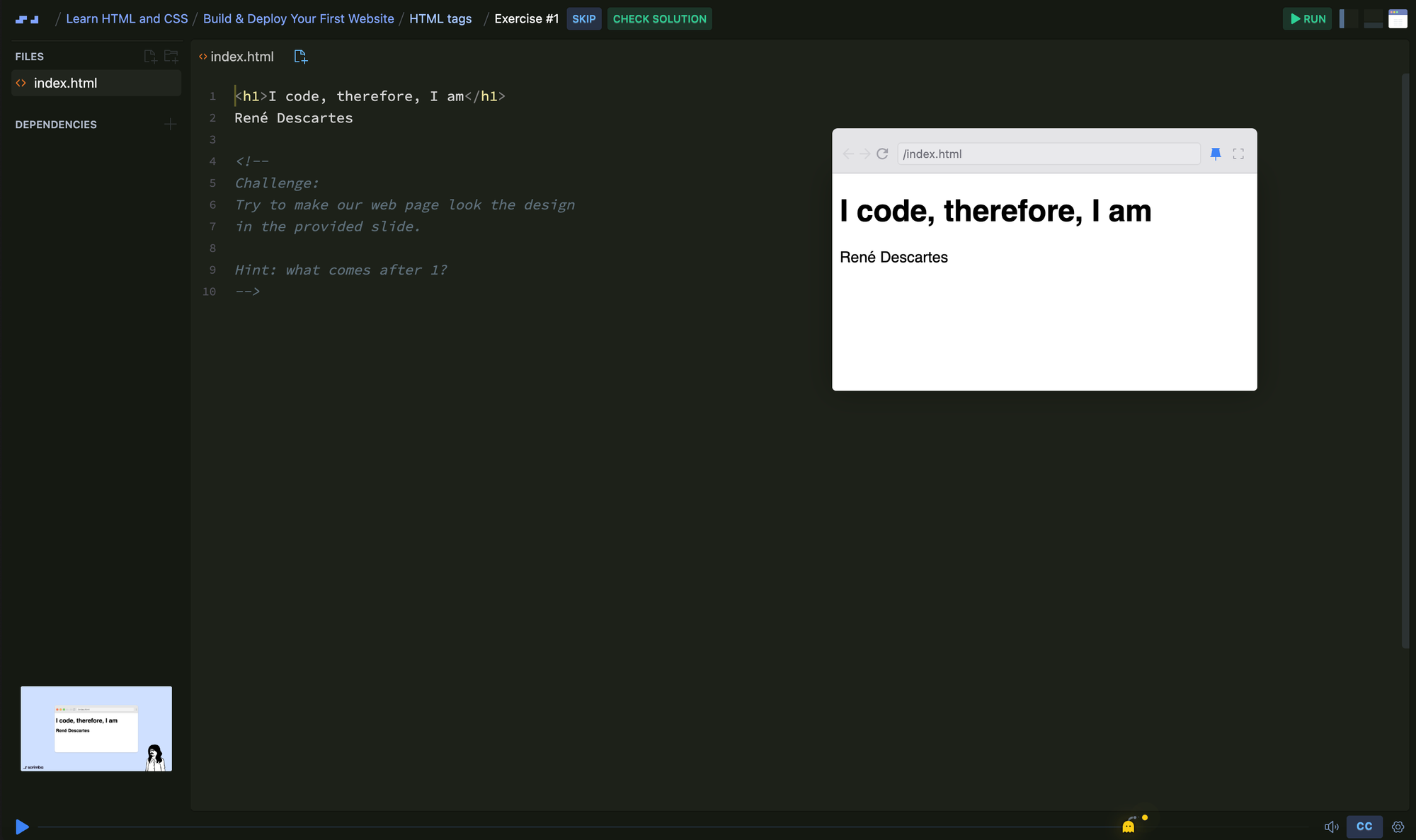
The free catalog is larger than most freemium platforms offer, and every free course carries a completion certificate:
- Web foundations: Learn HTML and CSS (5.7 hrs) and Learn JavaScript (9.4 hrs), both built in collaboration with Mozilla's MDN
- Frameworks: Learn React (15.1 hrs), Learn Next.js (8.5 hrs), and What's New in React 19? (69 min)
- Backend and data: Learn Node.js (3.5 hrs), Learn Express.js (4 hrs), and Learn SQL (3.8 hrs)
- Other languages: Learn Python (5.6 hrs) and Learn TypeScript (4.2 hrs)
- Practical skills: Command Line Basics (101 min), Deploying with Netlify (23 min), and Build and Deploy Your Portfolio (2.4 hrs) with Kevin Powell
Mozilla lists Scrimba as its course partner on the MDN Learn web development hub, an unusual external endorsement for a commercial platform and a signal that these courses track the MDN Curriculum rather than a proprietary syllabus.
The honest limit, per Scrimba's own documentation: the free tier covers roughly 25 courses with certificates but caps interactive challenge attempts at 10 slots across the account, and the four career paths sit behind Pro. Lessons stay watchable after that cap.
freeCodeCamp: Best Free Curriculum, Full Stop
freeCodeCamp is the most complete free coding curriculum available, and nothing else here matches its breadth for zero dollars. It is a nonprofit funded by donations, with no premium tier, no trial window, and no paywalled projects.
The current curriculum covers certifications in Responsive Web Design, JavaScript, Front-End Development Libraries, Python, Relational Databases, and Back-End Development and APIs, alongside a Certified Full-Stack Developer curriculum that consolidates the path into one track. Each certification requires building projects, not just passing quizzes.
Recent additions widen it further: a daily coding challenge, a free Foundational C# certification produced with Microsoft, interview-prep tracks including Project Euler and Rosetta Code, and a freeCodeCamp-hosted remix of The Odin Project curriculum.
The trade-off is format. Lessons are text-based, with no instructor on screen, which some learners find dry over hundreds of hours. Pacing is self-directed, so motivation has to come from you. The Scrimba vs freeCodeCamp breakdown covers where each format wins.
Best for self-motivated learners who want a full, genuinely free curriculum with recognized certifications.
The Odin Project: Best for Learning by Building
The Odin Project is free, open source, and deliberately hard. It offers two full paths, Full Stack JavaScript and Full Stack Ruby on Rails, and curates the best existing tutorials rather than producing its own lessons. Real developer tooling appears from day one: a local editor, Git, the terminal, and browser DevTools.
Expect frustration. Projects arrive with a specification and very little hand-holding. Where freeCodeCamp walks you through each step, Odin expects you to read documentation, search, and get stuck productively. That is the point, and also why absolute beginners sometimes stall in the first month.
CS50x: Best for Computer Science Fundamentals
CS50x is Harvard's introduction to computer science, free to take through its own OpenCourseWare site. The 2026 edition runs eleven weeks and moves from C to Python, then SQL, HTML, CSS, and JavaScript, ending in a final project.
The course teaches how computers work underneath the code, including memory, algorithms, and data structures. Two thirds of CS50 students have never taken a CS course before, so the prerequisites are lower than the reputation suggests. The problem sets are demanding, and the verified certificate through edX costs money even though the content does not.
Best for learners who want a university-grade foundation rather than the fastest path to a first website.
Codecademy Free Tier: Best for Sampling a Language
Codecademy's free tier gives basic access to introductory courses across a wide language range, with browser exercises and instant feedback. Nothing to install, so it is a low-friction way to test whether a language clicks. Codecademy Plus runs $29.99 per month billed monthly ($14.99 annually), and Pro runs $39.99 per month ($19.99 annually). Projects, quizzes, certificates, and career paths are all paid, so committed learners outgrow the free tier within weeks. The best online coding courses roundup is the wider comparison to read at that point.
Khan Academy: Best for Younger Learners
Khan Academy is a free nonprofit whose computing section introduces JavaScript, HTML/CSS, and SQL through visual, step-by-step lessons. It is strongest at making abstract ideas concrete for students who find other platforms overwhelming. The content is narrower than freeCodeCamp's or Odin's and is not a career track, so treat it as an on-ramp.
Free Resources for Practice, Reference, and Depth
Once the basics are in place, the bottleneck shifts from lessons to repetition and reference. These six free resources cover that stage.
- Full Stack Open from the University of Helsinki teaches React, Redux, Node.js, MongoDB, GraphQL, and TypeScript through graded exercises. It is free of charge, and both the certificate and University of Helsinki ECTS credits (5 to 14, depending on exercises completed) cost nothing. The strongest free intermediate JavaScript course anywhere.
- Exercism offers 83 language tracks and more than 8,500 exercises, with free human mentoring from experienced developers. It is CLI-first but runs every language in a browser editor, which makes trying an unfamiliar language cheap.
- Codewars provides community-authored challenges called kata, ranked by difficulty across 55+ languages. Comparing your solution against everyone else's afterward is where most of the learning happens. The coding practice platforms comparison covers how it fares against the alternatives.
- MDN Web Docs is Mozilla's reference for HTML, CSS, and JavaScript, and the one professional developers keep open. Its Learn area adds modules built around the MDN Curriculum.
- JavaScript.info is a free, book-length tutorial running from fundamentals through prototypes, promises, and modules. When a concept refuses to click, this is usually the explanation that fixes it.
- MIT OpenCourseWare publishes MIT course materials, including lecture videos, assignments, and exams. Its introductory programming courses give the academic grounding self-taught developers most often lack.
What "Free" Actually Means
Free splits into three models, and knowing which one you are in prevents an unpleasant surprise around week three.
| Model | What it means | Examples |
|---|---|---|
| Completely free | Full access, no premium tier, no paywalled content | freeCodeCamp, The Odin Project, Full Stack Open, MDN, JavaScript.info, Exercism, Codewars, MIT OpenCourseWare, Khan Academy |
| Freemium | A real free tier, with more content behind a subscription | Scrimba (free courses include certificates; career paths need Pro), Codecademy (basic courses free; projects and certificates paid) |
| Free with paid certificate | Content free, credential costs money | CS50x on edX, Coursera audit mode |
A free course gives lasting access to real material. A free trial is a countdown on paid content. Everything here is the former, which is why time-limited trials were left out.
The completely free platforms are enough to get hired. Plenty of working developers learned on freeCodeCamp and The Odin Project alone, as did people who came through free coding bootcamps. What freemium adds is format and structure, not better information. Scrimba's paid tier costs $24.50 per month on the annual plan ($294 per year) or $49 monthly, with regional, student, and promotional discounts available.
How to Choose a Free Coding Resource
Match the resource to how you learn, not to whichever platform gets recommended most:
- If you learn by doing, not watching: Scrimba's free courses are the only ones here where you edit the instructor's code inside the lesson.
- If you want one complete free curriculum: freeCodeCamp, with The Odin Project as the harder alternative.
- If you want academic depth: CS50x first, then MIT OpenCourseWare.
- If you know the basics and want React and Node depth: Full Stack Open, for free university credit.
- If you need reference and practice: MDN and JavaScript.info for reference, Exercism and Codewars for repetition.
Most people who finish do not use one site. A stack that works:
- Pick one curriculum and commit for at least three months. Switching platforms is the most common way free learners stall.
- Add one practice source for daily repetition, roughly 20 to 30 minutes.
- Keep one reference open while you build, so looking things up becomes a habit rather than a failure.
Then build something nobody assigned you. The project you chose yourself is the one that ends up in a portfolio and gets discussed in interviews.
Frequently Asked Questions
Can I really learn to code for free?
Yes. freeCodeCamp and The Odin Project are complete, entirely free curricula, and both have produced developers now working professionally. Harvard's CS50x adds university-grade computer science at no cost. No credit card and no trial period are required for any of them.
Is freeCodeCamp or Scrimba better for a complete beginner?
It depends on format. freeCodeCamp is text-based, comprehensive, and entirely free, which suits self-directed readers. Scrimba's free courses are interactive screencasts where you edit the instructor's code in the browser, which suits learners who lose focus reading long lessons. Both award free certificates.
Do free coding courses come with certificates?
Some do. freeCodeCamp issues free certifications for each completed track, Scrimba includes completion certificates with its free courses, and Full Stack Open grants a free certificate plus optional university credits. CS50x charges for its verified certificate, and Codecademy reserves certificates for paid plans.
What is the difference between a free course and a free trial?
A free course gives permanent access to real material with no payment expected. A free trial is time-limited access to paid content, usually 7 to 14 days, after which the content locks. Every resource in this guide offers permanently free access to at least part of its catalog.
Should I ever pay for a coding course?
Pay once free material has confirmed you enjoy coding and you want structure, faster feedback, or a guided path rather than more content. Paying earlier rarely helps, because the obstacle for most beginners is consistency and project practice, not access to information.
Key Takeaways
- Learning to code for free is realistic in 2026, and free options now include certificates, university credit, and full career-track curricula.
- freeCodeCamp is the most complete free curriculum, covering responsive web design, JavaScript, Python, databases, and back-end APIs with no paid tier at all.
- Scrimba's free tier is the deepest interactive one, spanning HTML and CSS through React, Next.js, Node, and SQL, with a completion certificate on every free course.
- Full Stack Open is the most underrated free resource, adding React and Node depth plus free University of Helsinki ECTS credits.
- "Free" means three different things: completely free, freemium, and free-with-paid-certificate. Check which applies before you start.
- Software developers earned a median of $133,080 per year as of May 2024, with 15% projected growth through 2034.
- Combining a curriculum, a practice site, and a reference beats any single platform alone.
Sources
- U.S. Bureau of Labor Statistics. "Software Developers, Quality Assurance Analysts, and Testers." Occupational Outlook Handbook, 2026. https://www.bls.gov/ooh/computer-and-information-technology/software-developers.htm
- Stack Overflow. "2025 Developer Survey: Technology." 2025. https://survey.stackoverflow.co/2025/technology
- freeCodeCamp. "Curriculum." July 2026. https://www.freecodecamp.org/learn/
- The Odin Project. "Paths." July 2026. https://www.theodinproject.com/paths
- Harvard University. "CS50x 2026." July 2026. https://cs50.harvard.edu/x/
- University of Helsinki. "Full Stack Open: General Info." July 2026. https://fullstackopen.com/en/part0/general_info
- Mozilla. "Learn web development." MDN Web Docs, July 2026. https://developer.mozilla.org/en-US/docs/Learn_web_development
- Exercism. "Language tracks." July 2026. https://exercism.org/
- Codewars. "Kata challenges." July 2026. https://www.codewars.com/
- Codecademy. "Pricing." July 2026. https://www.codecademy.com/pricing
- Scrimba. Self-reported product data: free course durations, certificates, free-tier limits, Pro pricing. July 2026.
![Clean Code Principles for Beginners [2026]](/articles/content/images/size/w600/2026/08/137-hero.jpg)
![CSS Variables: A Complete Guide [2026]](/articles/content/images/size/w600/2026/08/136-hero.jpg)
![AI Explainer Video Makers Compared [2026]](/articles/content/images/size/w600/2026/08/143-hero.jpg)
![Best ChatGPT Plugins for Creating Videos [2026]](/articles/content/images/size/w600/2026/08/142-hero.jpg)