Best Online Coding Courses and Classes Compared [2026]
Compare 12 online coding courses on format, price, free tier, and certificate, plus a five-question framework for picking the right one in 2026.

![Best Online Coding Courses and Classes Compared [2026]](/articles/content/images/size/w1200/2026/03/13.png)
There is no single best coding course, only the best one for a specific learner. Scrimba fits people who learn by writing code inside the lesson. freeCodeCamp fits self-directed learners who want a complete curriculum at zero cost. CS50 fits anyone after university-grade computer science. Coursera fits learners who need a recognized credential. Frontend Masters fits working developers filling gaps.
The stakes are worth getting right. The U.S. Bureau of Labor Statistics puts the 2025 median pay for software developers, QA analysts, and testers at $134,040, with 10% projected growth through 2035 and roughly 106,100 openings a year. Web developers and digital designers sit at a $99,520 median.
What follows compares 12 platforms on the five things that decide the outcome: format, price, what the free tier really includes, whether you get a certificate, and where each falls short. Prices verified July 2026.
How to Choose an Online Coding Course
Choosing an online coding course comes down to five things: what you want to build, how you learn, your budget, credential needs, and how much structure you need to finish.
Most roundups rank platforms as though one could be best for everyone. That framing is why so many people buy a subscription they abandon in week three. Work through these five questions instead, in order.
- What do you want to build? Websites and web apps point to JavaScript. Data analysis, automation, and machine learning point to Python. Pick the destination before the vehicle, because a platform that is excellent for frontend can be thin for data science.
- How do you actually learn? Be honest here. Some people absorb a lecture and go build. Others stall the moment the video stops and the editor is blank. If you are the second kind, you need a format where writing code and watching the lesson happen in one place.
- What shape is your budget? Three models behave differently. Free costs nothing but demands self-direction. Subscriptions are cheap monthly and expensive across two years. Per-course purchases are cheap once and add up fast over a curriculum.
- Do you need a credential or a portfolio? Most hiring managers weigh what you have built above what you completed. Certificates matter most when a company, a visa process, or a reimbursement scheme asks for one.
- How much structure do you need? People skip this question, and it decides whether they finish. A curated path with a fixed order and projects that build on each other beats an unlimited catalog for almost every beginner.
The best coding course is the one you are still using in month three. Every other criterion is downstream of that.
Run those five and the field narrows fast. Learn by doing, aiming at frontend or fullstack, want one predictable price? Scrimba. Zero budget and self-directed? freeCodeCamp or The Odin Project. Need a university-branded credential? Coursera or edX. Already shipping code professionally? Frontend Masters or Pluralsight.
Online Coding Course Comparison Table
The pricing column hides the biggest cost difference in the category. A subscription and a per-course marketplace look similar at a glance and diverge sharply across a full curriculum.
| Platform | Format | Price | Free tier | Certificate | Best for |
|---|---|---|---|---|---|
| Scrimba | Interactive screencasts, edited in place | $24.50/mo on annual ($294/yr) | Full courses | Yes, free courses included | Coding along inside the lesson |
| freeCodeCamp | Text lessons plus code challenges | Free | Everything | Yes, free | Zero budget, self-directed |
| The Odin Project | Curated reading plus large projects | Free | Everything | No | Minimal hand-holding |
| Codecademy | Browser text exercises | $14.99/mo annual (Plus), $19.99 (Pro) | Limited | Paid plans | Sampling many languages |
| Coursera | Video lectures, quizzes, projects | $59/mo or $399/yr (Plus) | Audit access | Paid plans | University-branded credentials |
| Udemy | Video from independent instructors | $19.99 to $199.99 per course, one-time | No | Yes | One topic, bought once |
| CS50 (Harvard via edX) | Lectures, problem sets, final project | Free to audit, $219 certificate | Full course | Paid | Computer science fundamentals |
| Frontend Masters | Recorded expert workshops | $39/mo or $390/yr | No | No | Working developers leveling up |
| Pluralsight | Video plus skill assessments | $21/mo billed yearly (Core Tech) | No | Yes | Enterprise, cloud, and IT |
| Boot.dev | Gamified backend lessons | $59/mo or $399/yr | Limited demo | Yes | Backend, gamified |
| Treehouse | Video plus challenges | $25/mo (Courses), $199/mo (Techdegree) | No | Yes | Video tracks, coached option |
| Mimo | Mobile-first bite-sized lessons | $9.99/mo billed yearly (Pro) | Yes | Yes | Practicing on a phone |
One column deserves a second look.
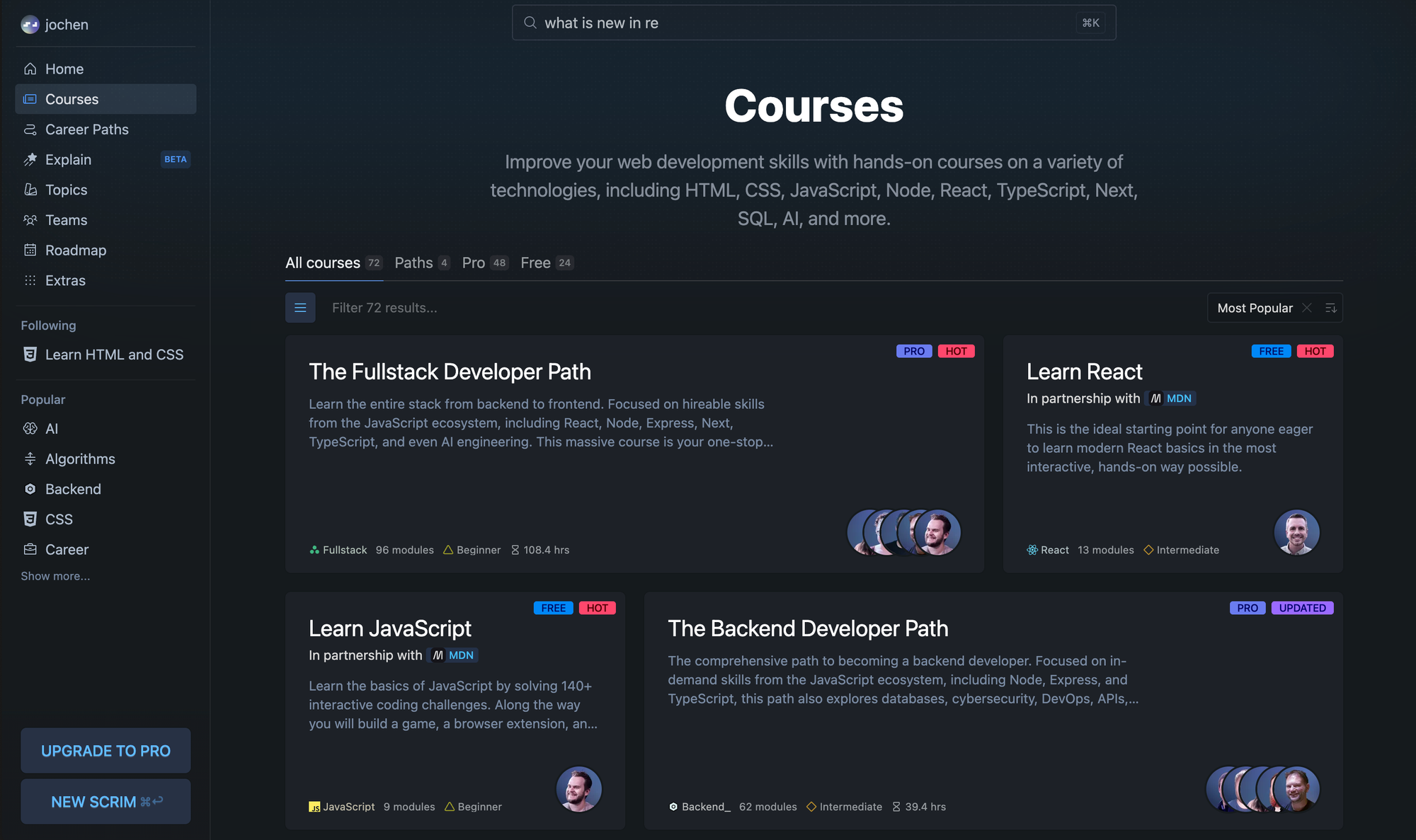
Free tier is where platforms differ most and describe themselves least clearly: freeCodeCamp and The Odin Project give away everything, Scrimba gives away complete courses with certificates, and several others give away a sampler.
The Best Online Coding Courses in 2026
Each entry below covers format, price, who it suits, and the limitation its own marketing will not mention.
Scrimba
Scrimba's format is its whole argument. Lessons are scrims, interactive screencasts where the video player is also the code editor: pause the instructor mid-sentence, edit their code, run it, carry on. No second window, nothing to copy across.
The free tier is unusually complete: Learn JavaScript at 9.4 hours, Learn HTML and CSS at 5.7 hours, Learn Python at 5.6 hours, and Learn React at 15.1 hours, all carrying a completion certificate. Paid access opens four career paths, including The Frontend Developer Path at 81.6 hours, curated in partnership with Mozilla MDN, and The Fullstack Developer Path at 108.4 hours. Pro costs $24.50 per month on the annual plan ($294 a year), with regional, student, and promotional discounts on top.
Best for: learners who stall when the video stops and the editor is blank. Where it falls short: no live cohorts or scheduled classes, no one-to-one career coaching, and a JavaScript-centric catalog. Python is covered as a beginner course, not as a data-science track.
freeCodeCamp
A donor-supported nonprofit with certification tracks across web development, Python, data science, and machine learning. Each certification is earned by building projects rather than by watching lessons.
"Every aspect of freeCodeCamp is 100% free." - freeCodeCamp
That claim is unusual in this category and it holds up: courses, projects, and certifications all cost nothing. The trade-off is format. Lessons are text and code challenges with no video instruction, so you carry the explanatory load, and learners who need someone to talk them through a concept tend to bounce off it. The head-to-head comparison with Scrimba goes deeper on that trade-off.
Best for: disciplined learners on a zero budget who want recognized free certifications.
The Odin Project
The Odin Project is a free, open-source curriculum built around large projects, with a strong community and a full stack JavaScript track.
Best for: self-starters who want to build real things early and do not mind assembling their own environment. Where it falls short: it curates other people's material rather than producing its own, so quality and tone shift between lessons. It also asks you to set up a local development environment before you have written much code, which is where many beginners quit.
Codecademy
Codecademy runs browser-based text exercises across a broad catalog of languages, which makes it the easiest place to try five languages in a weekend. Pricing starts with a free Basic tier, then Plus at $14.99 per month billed annually ($29.99 billed monthly) and Pro at $19.99 per month billed annually ($39.99 billed monthly).
Best for: exploring several languages before committing to one. Where it falls short: breadth costs depth, and the exercises are heavily scaffolded. The step from a guided fill-in-the-blank to a blank file on your own machine is larger than the lessons suggest.
Coursera
Coursera hosts courses from universities and companies including Google, Meta, and IBM, which is why its credentials carry the most name recognition here. Most courses can be audited free, and Coursera Plus costs $59 per month or $399 per year.
Best for: learners who need a credential a recruiter will recognize on sight. Where it falls short: the format is lecture video with quizzes, and you usually write code somewhere else entirely. Quality varies across partners, so the brand on the certificate matters more than the platform behind it.
Udemy
Udemy is a marketplace, not a curriculum. Courses list between $19.99 and $199.99 as one-time purchases with lifetime access, and site-wide sales run close to continuously, so the list price is rarely what anyone pays. The upside is real: buy one course on one topic and own it forever, no subscription clock running.
There is also no quality floor. The instructor decides whether a course is excellent or three years stale, nothing obliges anyone to update it, and sequencing a full curriculum falls to you.
Best for: one specific topic you want to own outright rather than rent.
CS50 from Harvard
CS50x is Harvard's introduction to computer science, free to audit through edX, covering C, Python, SQL, JavaScript, and the fundamentals of algorithms and memory. A verified certificate costs $219.
Best for: building a genuine computer science foundation rather than a job-ready web stack. Where it falls short: it is demanding, self-paced in name only given the workload, and it does not aim to make you employable as a web developer. Most people finish CS50 and still need a framework course afterwards.
Frontend Masters
Frontend Masters sells recorded workshops taught by framework authors and senior practitioners, at $39 per month or $390 per year, covering JavaScript, TypeScript, React, CSS, and system design in real depth.
Best for: developers who already ship code and want to go deeper on one topic. Where it falls short: it assumes you can already program. There is no beginner on-ramp, and because the workshops are recordings of live sessions, the pace is set by a room you were not in.
Pluralsight
Pluralsight targets working technology professionals with video courses and skill assessments across cloud, security, data, and enterprise stacks. Core Tech is $21 per month billed yearly ($30 monthly), Complete is $39 per month billed yearly ($55 monthly).
Best for: IT and enterprise developers, especially anyone whose employer pays. Where it falls short: the catalog is built for people already in the industry. Beginner web development coverage is thin for the price, and the format is video without an integrated editor.
Also worth knowing
Three more platforms, worth a look if their specific angle matches yours. Boot.dev is backend-focused and gamified at $59 per month or $399 per year, with a free tier that works as a demo rather than a curriculum. Treehouse runs $25 per month for Courses, $49 for Courses Plus, and $199 for the coached Techdegree. Mimo is mobile-first, Pro at $9.99 per month billed yearly and Max at $24.99, which makes it a good supplement and a weak primary.
Free vs Paid Coding Courses
Free coding courses are complete curricula in several cases, not trial versions, so the real trade-off is not content access but structure, feedback, and accountability.
What free gets you:
- Complete curricula from freeCodeCamp and The Odin Project, with nothing held back
- Harvard-level computer science through CS50, with a paid certificate only if you want one
- Full interactive courses on Scrimba, certificate included, which most freemium platforms reserve for paying users
- Communities that answer questions faster than most paid support desks
What paying tends to buy:
- A curated order, so you are not deciding what to learn next every week
- Projects that build toward a portfolio instead of sitting as isolated exercises
- Faster feedback when your code breaks, which is where unsupported learners lose the most time
The honest verdict: if you are disciplined and comfortable reading documentation, a free platform gets you to the same place, and plenty of working developers took exactly that route. If you have started and stalled before, the money is not buying content, it is buying a path, and the path is usually what was missing. For more no-cost options, see the best free coding websites and resources; for a heavier commitment, compare against coding bootcamps before spending five figures.
Pick one platform, give it ninety days, and ship three projects you would show someone. That decision matters more than which of these twelve you chose, though it helps to know how long the whole thing realistically takes.
Frequently Asked Questions
What is the best online coding course for beginners?
For beginners who learn by doing, Scrimba's interactive format keeps writing and watching in one place. For beginners on a zero budget, freeCodeCamp offers a complete free curriculum with certifications. For beginners who want computer science rather than web development, CS50 from Harvard is free to audit.
How much does a coding course cost?
Online coding courses range from free to roughly $60 per month. Subscriptions run about $10 to $59 monthly, with annual billing usually cheaper. Marketplace courses on Udemy are one-time purchases between $19.99 and $199.99. freeCodeCamp and The Odin Project cost nothing at all.
Can you learn to code with free online courses?
Yes. freeCodeCamp and The Odin Project publish complete curricula at no cost, CS50 is free to audit, and Scrimba's free courses include completion certificates. Free works when you can hold your own schedule. It works less well if you need external structure and deadlines to finish.
How long does an online coding course take?
A single beginner course typically takes 5 to 15 hours. A full career path runs 80 to 110 hours of instruction, which most people spread over six to twelve months alongside other commitments. Reaching job-ready standard usually takes longer than the course length suggests, because building projects takes time.
Do employers accept online coding certificates?
Certificates help, but portfolios decide. Most hiring managers weigh what you have built above what you have completed, so treat a certificate as evidence of consistency rather than as the qualification itself. University and employer-branded credentials from Coursera or edX carry the most name recognition.
Key Takeaways
- The right coding course depends on format fit, budget shape, credential need, and how much structure you need to finish, not on a universal ranking.
- Scrimba's scrim format puts the code editor inside the video player, and its free courses include completion certificates, which most freemium platforms do not.
- freeCodeCamp and The Odin Project are free end to end, with no locked content and no paid tier.
- Subscription pricing spans roughly $10 to $59 per month, while Udemy sells per course between $19.99 and $199.99 with lifetime access.
- CS50 is free to audit and teaches computer science fundamentals rather than a job-ready web stack.
- Frontend Masters and Pluralsight assume you can already code and are poor first stops for beginners.
- U.S. software developers had a 2025 median wage of $135,980 with 10% projected growth through 2035, per the Bureau of Labor Statistics.
Sources
- U.S. Bureau of Labor Statistics. "Software Developers, Quality Assurance Analysts, and Testers." Occupational Outlook Handbook, 2024. https://www.bls.gov/ooh/computer-and-information-technology/software-developers.htm
- U.S. Bureau of Labor Statistics. "Web Developers and Digital Designers." Occupational Outlook Handbook, 2024. https://www.bls.gov/ooh/computer-and-information-technology/web-developers.htm
- freeCodeCamp. "About freeCodeCamp." 2026. https://www.freecodecamp.org/news/about/
- The Odin Project. "About." 2026. https://www.theodinproject.com/about
- Harvard University. "CS50: Introduction to Computer Science." 2026. https://pll.harvard.edu/course/cs50-introduction-computer-science
- Vendor pricing pages, accessed July 2026: Coursera, Codecademy, Udemy, Frontend Masters, Pluralsight, Boot.dev, Treehouse, Mimo. Scrimba course durations and pricing are self-reported.