How to Learn to Code for Free [2026]
A method for learning to code for free in 2026: one goal, one curriculum, a 12-week plan, free code review, and when paying finally makes sense.

![How to Learn to Code for Free [2026]](/articles/content/images/size/w1200/2026/07/119-hero-1.jpg)
You can learn to code for free in 2026, and the free material is not the bottleneck. freeCodeCamp, The Odin Project, Harvard's CS50x, and the University of Helsinki's Full Stack Open are complete curricula that cost nothing. The bottleneck is finishing. Across 221 open online courses, the median completion rate was 12.6%.
So this guide is a method, not a list. Pick one goal, commit to one curriculum, follow a week-by-week plan, build before you feel ready, get free code review, and learn the one signal that means paying is finally worth it.
Why Do Most People Who Learn to Code for Free Quit?
Free coding curricula are complete and abundant. Most learners stop anyway, because free removes the cost without supplying the structure that makes learning finish.
The material really is not the problem. freeCodeCamp publishes free certifications in Responsive Web Design, JavaScript, Front-End Development Libraries, Python, Relational Databases, and Back-End Development and APIs, plus a Certified Full-Stack Developer curriculum, with no premium tier anywhere. The Odin Project is open source and community-funded. Harvard publishes CS50x free, and the University of Helsinki gives away Full Stack Open along with real ECTS credits.
Attrition is the problem. Research by Katy Jordan at The Open University analyzed enrollment and completion data from 221 open online courses and found completion rates ranging from 0.7% to 52.1%, with a median of 12.6%. Longer courses completed significantly less often than short ones, and the first and second weeks turned out to be where engagement was won or lost.
Free removed the invoice. It did not remove the syllabus, the deadlines, or the person checking whether you showed up. Learning to code for free means supplying all three yourself, and that is the actual skill this guide teaches.
One structural obstacle deserves naming early. The U.S. Bureau of Labor Statistics lists a bachelor's degree as the typical entry-level education for software developers, so a self-taught applicant enters the field without the default credential. The portfolio has to do that work instead, which is why projects start in week two of the plan below and not week ten.
Self-directed free learning is not a beginner's compromise either. In the 2025 Stack Overflow Developer Survey, 69% of working developers had learned something new in the past year, drawing mostly on technical documentation (67.8%) and other online resources (58.7%) rather than formal courses (32.7%).
For calendar expectations, the guide on how long it takes to learn to code beats any platform's marketing as a planning tool.
Step 1: Pick One Goal and One Language Before You Pick a Platform
The most expensive mistake in free learning is collecting resources instead of choosing one. Deciding what you want to build first collapses the platform question almost immediately.
| If your goal is | Start with | A free starting point |
|---|---|---|
| Websites and web apps | HTML and CSS, then JavaScript | Learn HTML and CSS (5.7 hrs), then Learn JavaScript (9.4 hrs) |
| Data, scripting, automation | Python | Learn Python (5.6 hrs) or freeCodeCamp's Python certification |
| Backend services and APIs | JavaScript, then SQL | Learn Node.js (3.5 hrs) and Learn SQL (3.8 hrs) |
| A computer science foundation | C, then Python | CS50x, which runs eleven weeks from Scratch through C, Python, SQL, and web |
| Still undecided | JavaScript | Anything that runs in a browser, because the feedback loop is shortest |
Every Scrimba course in that table sits on the free tier and includes a completion certificate.
Two rules make the decision stick. A language is a means to a first shipped thing, not an identity, so the right answer is whichever one your goal points at. And switching languages in month one resets the clock, because the hard part you were about to reach is the part that transfers.
Step 2: Commit to One Primary Curriculum for 90 Days
One primary, many satellites. One curriculum sets the order of what you learn. Everything else gets consulted on demand and never followed in parallel.
The credible free primaries differ less in quality than in who they suit:
- freeCodeCamp is the broadest and entirely free, with certifications that require building projects rather than passing quizzes. The format is text-based with no instructor on screen, which suits self-directed readers and wears on everyone else.
- The Odin Project is project-first and deliberately hard, with local tooling from day one. It curates existing tutorials rather than producing lessons, and absolute beginners sometimes stall in the first month.
- CS50x teaches how computers work underneath the code. Harvard notes that two thirds of CS50 students have never taken a computer science course before, so the prerequisites are lower than the reputation suggests.
- Full Stack Open is the strongest free intermediate JavaScript course anywhere, covering React, Redux, Node.js, MongoDB, GraphQL, and TypeScript. Helsinki budgets 15 to 20 hours per part across fourteen parts, and both the certificate and the ECTS credits are free.
- Scrimba's free courses use an interactive screencast the learner can pause to edit the instructor's code directly in the browser, so there is no context switch between watching and typing.
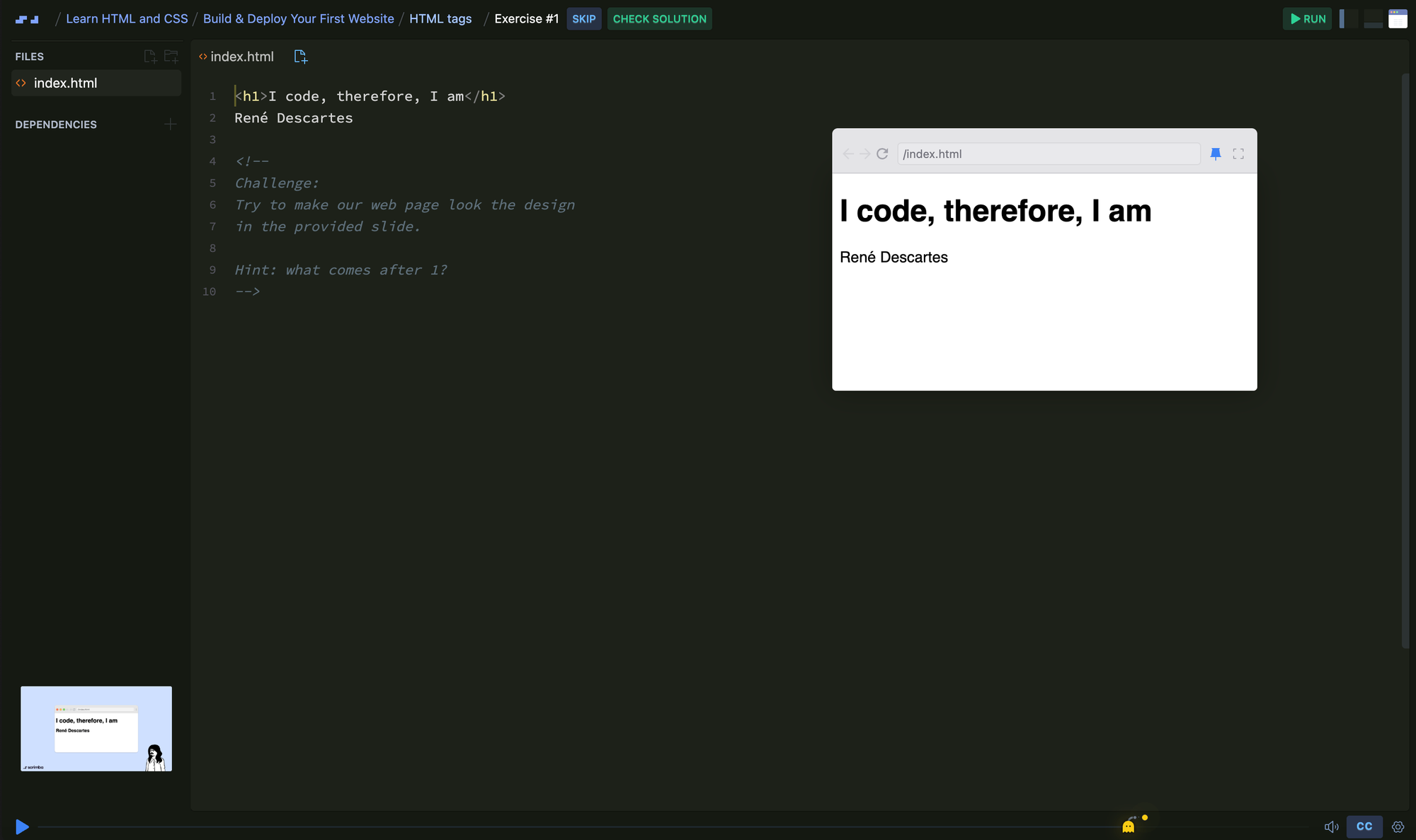
Scrimba's honest limit belongs here too: the free tier spans roughly 25 courses with certificates but caps interactive challenge attempts at 10 slots across the whole account, and the four career paths require Pro. Lessons remain watchable after that cap. The Scrimba vs freeCodeCamp comparison covers where each format wins.
Satellites are for lookup, not sequence. MDN Web Docs is the reference professional developers keep open, and documentation plus search is what the Stack Overflow data shows they rely on most.
If the open question is still which free platforms exist and where each paywall sits, the companion piece on the best free coding websites and resources compares twelve of them side by side. This guide assumes that choice is made and deals with what happens afterward.
Step 3: Follow a Week-by-Week Plan for the First Three Months
Jordan's finding that weeks one and two decide engagement has a direct design consequence: something has to ship almost immediately. The plan below front-loads a visible result and delays framework work until the fundamentals hold.
| Weeks | Focus | Free resources | What you ship | Hours/week |
|---|---|---|---|---|
| 1-2 | HTML, CSS, editor setup | Learn HTML and CSS, MDN | A one-page site, live on the internet | 8-10 |
| 3-4 | Language fundamentals | Learn JavaScript or Learn Python | Two small programs that run start to finish | 8-12 |
| 5-6 | The DOM, APIs, fetching data | Primary curriculum, MDN reference | An app that displays live data from a public API | 10-12 |
| 7-8 | Command line, Git, deployment | Command Line Basics (101 min), Deploying with Netlify (23 min) | The week 5 app deployed, with a public repository | 8-10 |
| 9-10 | One framework or one data layer | Learn React (15.1 hrs) or Learn SQL | A multi-screen app, or a queryable dataset | 10-14 |
| 11-12 | Unassigned project and portfolio | Build and Deploy Your Portfolio (2.4 hrs) | Something nobody assigned you, plus a portfolio site | 10-14 |
Be honest about what twelve weeks at ten hours buys. Roughly 120 hours is a foundation and a portfolio start, not a job offer. Full Stack Open alone budgets 15 to 20 hours per part across fourteen parts, so the intermediate stretch that follows is longer than the beginner stretch before it.
Two adjustments matter more than the exact schedule. Fix the hours to specific days rather than a weekly total, because "ten hours a week" quietly becomes zero by Thursday. And treat weeks 1-2 as the load-bearing ones: if you are going to over-invest anywhere, over-invest there, where the research says attrition concentrates.
Step 4: Start Building Projects Before You Feel Ready
Passive completion feels like progress and produces almost none. This is the failure mode a free learner has nobody to catch, because no instructor is checking whether you finished something or merely followed along.
The escape is a fixed sequence:
- Rebuild something that already exists. A weather widget, a tip calculator, a page you like. Copying the target is fine; copying the solution is not.
- Modify it until it is no longer that thing. Change the data source, add a second view, break it deliberately and repair it.
- Build the smallest version of your own idea. One screen, one feature, no accounts, no database.
- Finish and deploy it, ugly or not. Deployment is part of the project. An undeployed project does not exist to a hiring manager.
- Write down what broke. Two paragraphs in the README. This becomes interview material later, and it is the only record that you debugged rather than restarted.
The shortlist of coding project ideas for beginners helps when step three stalls on what to build.
Step 5: Get Free Code Review and Build Accountability
Working code and good code diverge quietly, and without review that gap widens for months. Free feedback exists, but each channel is good at a different thing:
- Exercism offers free human mentoring from volunteer developers across 83 language tracks. It is the closest thing to real code review that costs nothing.
- Platform Discords and community forums are excellent for getting unblocked in minutes and poor for architecture questions, which need more context than a chat message carries.
- Open source teaches review standards before you ever receive one. Read the pull request discussions on an active repository and you learn what reviewers object to in practice.
- AI assistants work as a fast first pass. Treat one as a rubber duck rather than a reviewer, because a model will confidently approve code that runs and is structured badly.
Accountability is the other half. A public build log, one fixed weekly commitment, and one person who expects an update outperform any productivity system, and all three are free. Set them up in week one, because week six is after the drop-off.
Free vs Paid: When Paying Becomes the Rational Choice
Free is not a lesser version of paid. It is a different trade: money stays in your pocket and time leaves it, because you become the curriculum designer, the scheduler, and the accountability system.
| What you need | Free handles it | Worth paying for |
|---|---|---|
| Access to information | Completely. Nothing important is paywalled | No |
| Sequencing and structure | Partly. Curricula give order, not pacing | Yes, if you keep restarting |
| Feedback speed | Slowly. Volunteer mentors answer when free | Yes, if slow feedback is stalling you |
| Accountability | Only if you build it yourself | Yes, if self-built systems have failed twice |
| Credentials | freeCodeCamp, Full Stack Open, and Scrimba's free courses all certify | No |
| Career support and interview prep | Thinly | Yes, if you are applying now |
| Deadlines | Not at all | Yes, if nothing else has worked |
Paying becomes rational when free material has already confirmed you enjoy this, you have shipped at least one project, and the blocker is structure or feedback rather than access. Paying is not rational when the goal is to buy motivation you do not have yet, or when nothing free has been finished. A subscription does not fix a consistency problem; it adds an invoice to it.
For reference, Scrimba's paid tier runs $24.50 per month on the annual plan ($294 per year), with regional, student, and promotional discounts available, and its free courses carry completion certificates regardless.
How Do You Know You Are Ready to Apply for Jobs?
You are ready when you can build a small application from an empty folder, unaided, and debug by forming a hypothesis rather than searching.
Four signals matter more than hours logged:
- You start from a blank folder and get to something running, without a tutorial open.
- You debug by forming a hypothesis, not by pasting the error and hoping.
- Two or three deployed projects exist with public repositories and readable commit histories.
- You can explain a technical decision out loud, including what you rejected.
The market rewards getting there. BLS puts the median annual wage for software developers at $135,980 as of May 2025, with 10% projected growth from 2025 to 2035 and about 106,100 openings a year. Against a default expectation of a degree, the portfolio is the credential, which is what makes steps 4 and 5 the ones not to skip. The guides on building a developer portfolio and landing your first developer job cover what comes next.
Frequently Asked Questions
Can you really learn to code for free and get a job?
Yes. freeCodeCamp, The Odin Project, CS50x, and Full Stack Open are complete curricula that cost nothing, and developers have been hired on the strength of projects built from them. What free does not provide is structure, deadlines, or career services, so those have to be self-supplied.
How long does it take to learn to code for free?
Most people reach a working foundation in three months at eight to twelve hours a week, and job readiness in six to twelve months. Free learning tends to run longer than paid, because time is spent choosing and sequencing resources rather than following a set path.
What is the best free way to learn to code as a complete beginner?
Pick one goal, one language, and one primary curriculum, then ship something small in the first two weeks. freeCodeCamp suits self-directed readers, The Odin Project suits people who want difficulty early, and interactive platforms suit learners who lose focus reading long lessons.
Do free coding courses come with certificates?
Some do. freeCodeCamp issues free certifications for each completed track, Full Stack Open grants a free certificate plus University of Helsinki ECTS credits, and Scrimba includes completion certificates on its free courses. CS50x charges for its verified certificate even though the course itself is free.
When should you switch from free resources to a paid course?
Switch once free material has confirmed you enjoy coding, you have finished and deployed at least one project, and your blocker is structure or feedback rather than access to information. Paying before finishing anything free usually buys more content, not more progress.
Key Takeaways
- Free material is not the limiting factor. freeCodeCamp, The Odin Project, CS50x, and Full Stack Open cover everything a junior role asks for at no cost.
- Finishing is the limiting factor. Across 221 open online courses, completion ranged from 0.7% to 52.1% with a median of 12.6%, and longer courses finished worse.
- Weeks one and two decide the outcome, so ship something visible immediately rather than saving projects for later.
- One primary curriculum, many satellites. Following two curricula in parallel is the most common way free learners stall.
- Twelve weeks at ten hours is about 120 hours, which buys a foundation and a portfolio start, not a job offer.
- Free code review exists, through Exercism's volunteer mentoring, open source review threads, and community Discords.
- Pay when the blocker is structure or feedback, never to buy motivation you do not have yet.
Sources
- Jordan, Katy. "Massive Open Online Course Completion Rates Revisited: Assessment, Length and Attrition." International Review of Research in Open and Distributed Learning 16, no. 3, 2015. https://files.eric.ed.gov/fulltext/EJ1067937.pdf
- U.S. Bureau of Labor Statistics. "Software Developers, Quality Assurance Analysts, and Testers." Occupational Outlook Handbook, 2026. https://www.bls.gov/ooh/computer-and-information-technology/software-developers.htm
- Stack Overflow. "2025 Developer Survey: Developers." 2025. https://survey.stackoverflow.co/2025/developers/
- freeCodeCamp. "Curriculum." August 2026. https://www.freecodecamp.org/learn/
- The Odin Project. "Paths." August 2026. https://www.theodinproject.com/paths
- Harvard University. "CS50x 2026: Introduction to Computer Science." August 2026. https://cs50.harvard.edu/x/
- University of Helsinki. "Full Stack Open: General Info." August 2026. https://fullstackopen.com/en/part0/general_info
- Exercism. "Mentoring." August 2026. https://exercism.org/mentoring
- Mozilla. "Learn web development." MDN Web Docs, August 2026. https://developer.mozilla.org/en-US/docs/Learn_web_development
- Scrimba. Self-reported product data: free course durations, certificates, free-tier limits, Pro pricing. August 2026.