AI Video APIs: Generative Clips, Avatars or Narrated Explainers
Compare AI video APIs by job: Gemini Omni Flash and Runway for clips, HeyGen and Synthesia for avatars, Scrimba Explain for narrated explainers. Prices and limits.

Pick a video generation API by what the finished video has to be. There are three different jobs behind the search, and each has its own APIs.
A generated clip is a short shot made from a text prompt or an image: Gemini Omni Flash in the Gemini API and the Runway API do this. An avatar presenter is a person on screen reading your script: HeyGen and Synthesia. A narrated explainer teaches something from a prompt or a document you send. Scrimba Explain's Explainer API does that job: it turns a prompt or a document into a narrated explainer, with slides of code, diagrams and a spoken walkthrough.
If you built on Veo in the Gemini API, note the change first. Google shut down Veo 3.1 Preview in the Gemini API on October 22, 2026 and points new work to Gemini Omni Flash.
One more split before you start: "video API" also means streaming and hosting. Mux and api.video store, encode and deliver video you already have. They are video infrastructure, and this guide leaves them out.
Which AI Video API Fits Your Job?
The right AI video API depends on whether you need a short generated shot, a person reading a script, or a lesson that explains your material.
| API | Job | You send | You get back | Billed by |
|---|---|---|---|---|
| Gemini Omni Flash | Generated clip | Text, images, a short video | A 3 to 15 second MP4 with sound | Output tokens, about $0.07 a second at 720p |
| Runway API | Generated clip | Text or an image, plus a model name | A clip from Runway's or a partner's model | Credits per second of output |
| Scrimba Explainer API | Narrated explainer | A prompt, up to 5 files | A narrated lesson: slides, diagrams, code and voice | Your Scrimba plan, free or Pro |
| HeyGen | Avatar presenter | An avatar, a script, a voice | An MP4 of the avatar speaking | Dollars per minute of video |
| Synthesia | Avatar presenter | Scenes with an avatar, background and script | An MP4 of the avatar speaking | Credits from a Pro or higher plan |
Inputs, outputs and billing from each vendor's API docs and pricing pages, November 2026.
Three questions settle most choices. Does the video need a person on screen? Then it is HeyGen or Synthesia; Scrimba Explain makes slides with narration and has no avatars. Does it have to teach something from material you hold, such as a doc, a code file or a policy? That is the narrated-explainer job. Is it a short visual shot for a product page or an ad? That is a generated clip.
The jobs also differ in length. A clip model returns seconds of footage per request, while an avatar or explainer API returns a whole video from one call.
Generated Clips: Gemini Omni Flash and Runway
A generated clip API turns a text prompt or an image into a short video shot, a few seconds long, with no script or slides behind it.
Gemini Omni Flash in the Gemini API
Google's current video model in the Gemini API is gemini-omni-1.2-flash. It takes text, images and video up to 15 seconds long, and returns video with native audio from 3 to 15 seconds, at 360p up to 4K and 24 fps (model page). You can edit a result in follow-up turns and extend it to 30 seconds in total.
Requests go to the Interactions API. This is the REST example from Google's guide:
curl -X POST "https://generativelanguage.googleapis.com/v1beta/interactions?key=$API_KEY" \
-H "Content-Type: application/json" \
-d '{
 "model": "gemini-omni-1.2-flash",
 "input": "A marble rolling fast on a chain reaction style track, continuous smooth shot."
}'
The response carries the MP4 as base64 inside its steps array, and larger videos come back as a file URI to poll.
Omni Flash has no free tier. Output costs about $0.07 a second at 720p, or roughly $0.70 for a 10-second clip (pricing, Nov 2026). Rate limits apply per project: Tier 1 allows 8 requests a minute and 40 a day, Tier 3 allows 40 and 2,000.
Two details matter for a product build. Every generated video carries an invisible SynthID watermark, and editing or extending uploaded videos is not available to users in the EEA, Switzerland and the UK. Requests to gemini-omni-1.1-flash route to 1.2 on December 3, 2026.
Runway API
The Runway API sells one key for many models: Runway's own Gen-4.5 and Gen-4 Turbo, and partner models such as Veo 3.1, Kling, Seedance and Gemini Omni Flash. You pay in credits at $0.01 each, and Gen-4.5 costs 12 credits a second, so a 10-second clip is $1.20 (pricing, Nov 2026).
The docs' quick test is one cURL call that starts a task:
curl -X POST https://api.dev.runwayml.com/v1/image_to_video \
  -d '{
    "promptImage": "https://upload.wikimedia.org/wikipedia/commons/8/85/Tour_Eiffel_Wikimedia_Commons_(cropped).jpg",
    "promptText": "A timelapse on a sunny day with clouds flying by",
    "model": "seedance2_5",
    "ratio": "1280:720",
    "duration": 5
  }' \
  -H "Content-Type: application/json" \
  -H "Authorization: Bearer $RUNWAYML_API_SECRET" \
  -H "X-Runway-Version: 2024-11-06"
You get a task ID back and poll it until the video is ready. Runway's usage tiers set how many generations run at once per model, with no requests-per-minute limit: extra tasks wait in a queue as THROTTLED. A daily cap counts over a rolling 24 hours, and Tier 1 caps spend at $100 a month.
For how these models build a clip frame by frame, see how text-to-video AI works.
Narrated Explainers: Scrimba's Explainer API
A narrated explainer API turns a prompt or a document into a lesson: slides with code, diagrams or images, and a voice that walks through them.
Scrimba makes Scrimba Explain, and its Explainer API puts it inside your own product. Think of a lesson for every course page or a walkthrough of each internal doc: material you already have, turned into something people watch. Each explainer is built on the spot from that material, with nothing to film or record.
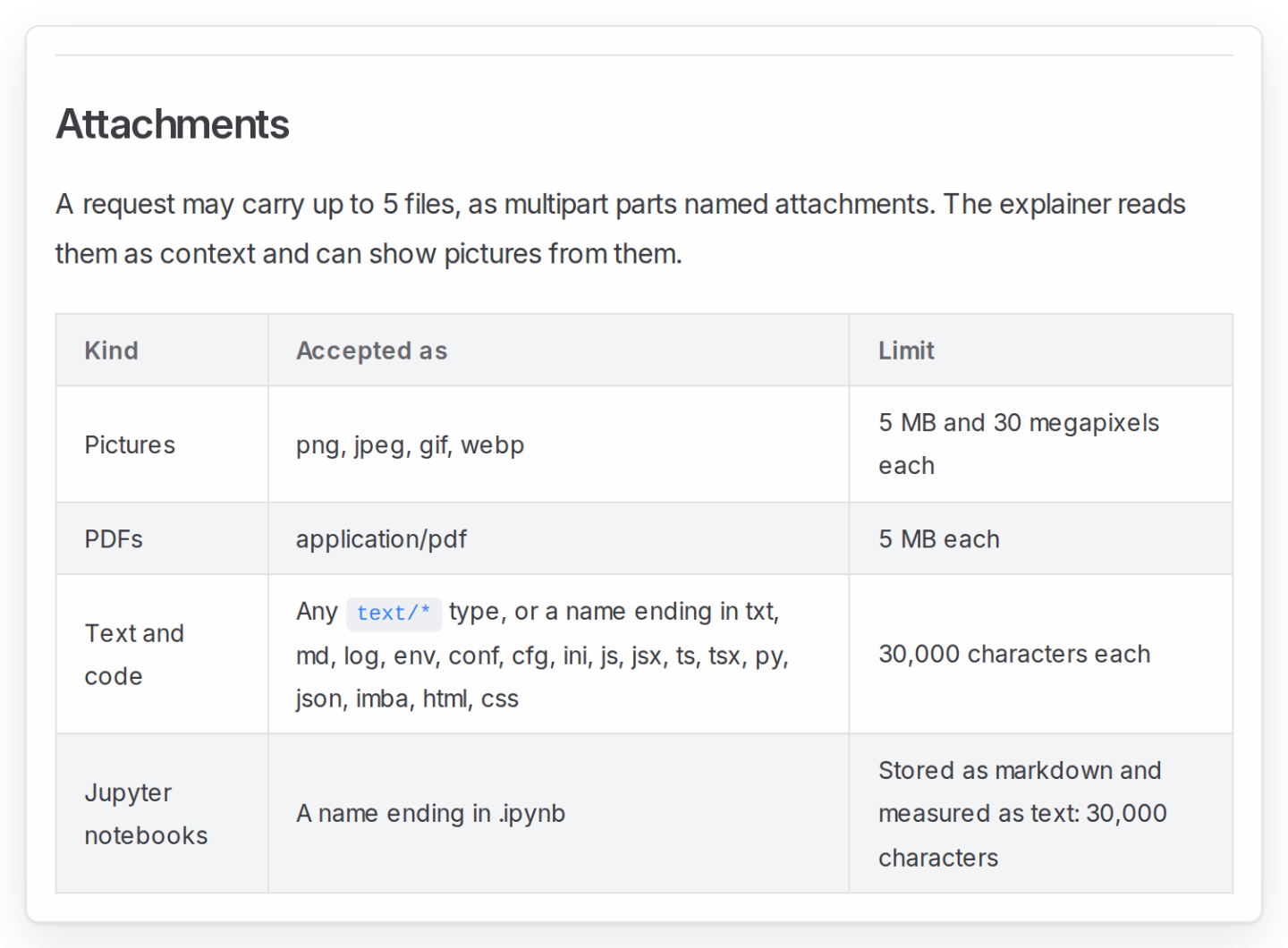
One request does the work. Send a prompt of up to 12,000 characters, or attach up to five files: pictures and PDFs up to 5 MB each, text and code files up to 30,000 characters each. A short explainer is ready in under a minute and a long one takes a few minutes. This is the create request from the API docs:
curl -s "https://scrimba.com/api/v1/explainers" \
  -H "Authorization: Bearer $SCRIMBA_KEY" \
  -H "Content-Type: application/json" \
  -d '{
    "prompt": "Explain how HTTP caching headers decide what a browser keeps",
    "mode": "landscape",
    "privacy": "unlisted",
    "language": "en"
  }'
The request sets privacy to unlisted on purpose. Explainers made through the API start private, and a private explainer shows visitors nothing in an embed. Unlisted or public ones embed with an iframe, and visitors need no Scrimba account to watch.
The result plays like Scrimba's published example What is a RESTful API?: an analogy, a diagram of client, API and server, cards for GET, POST, PUT and DELETE, and a code slide with a real fetch request.
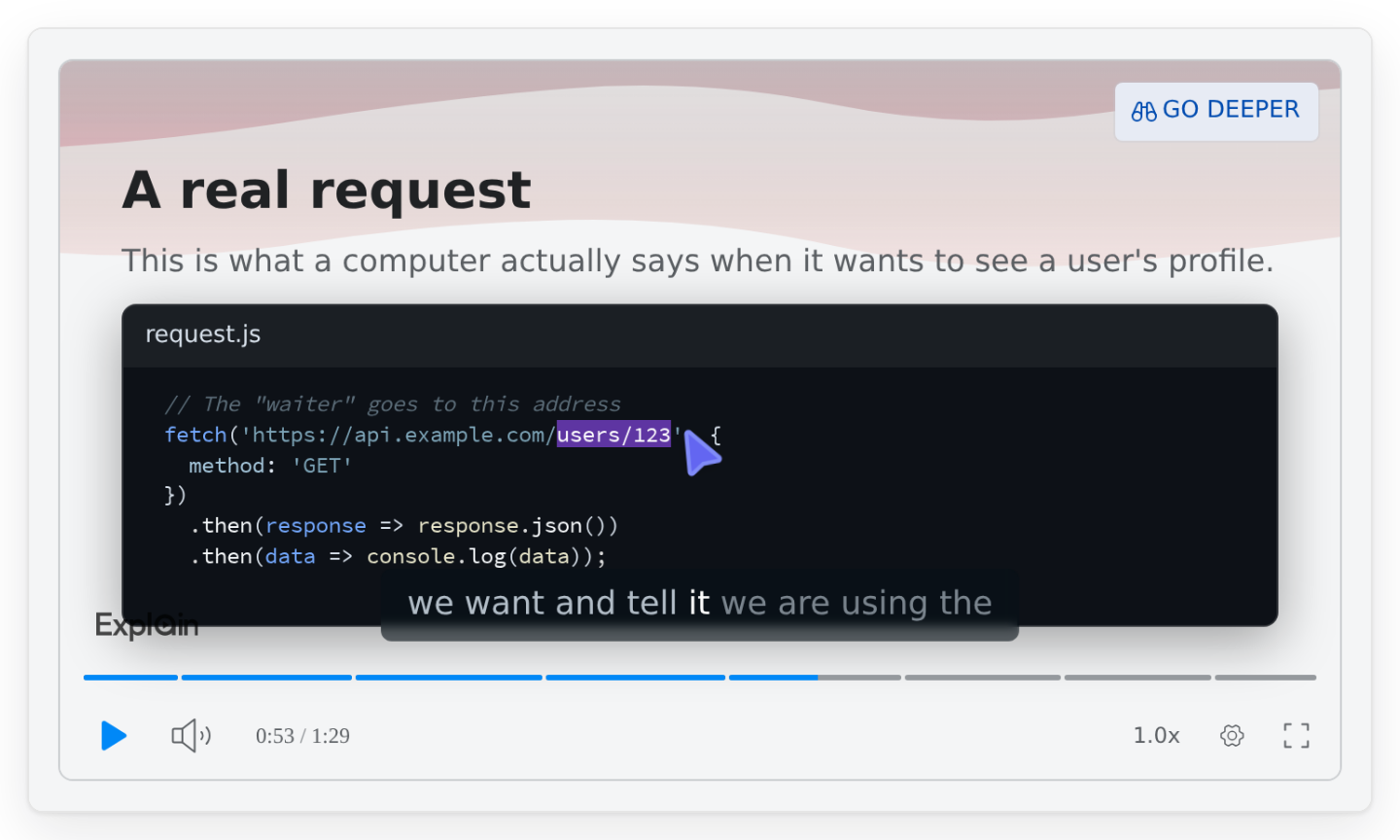
Three options suit developers in particular. Narration comes in 33 languages, each with a native voice. Frames are landscape by default, with portrait and square on request. And cite_attachments: true makes the narration cite the parts of your text and code files it teaches from, which you read back from the transcript endpoint.
Scrimba Explainer API terms
The API is open to every Scrimba account: create a key in your settings and call https://scrimba.com/api/v1. Explainers made with a key belong to that account and count toward its limit. Pro, which is the account's Scrimba Pro subscription, allows 100 explainers a month and adds commercial use and the watermark: false option.
To see explainers of real code before you wire the API into a product, read the guides on explaining a pull request to your team and on architecture onboarding videos.
Avatar Presenters: HeyGen and Synthesia
An avatar video API renders a lifelike person, stock or modeled on someone real, who speaks your script in a chosen voice.
HeyGen
HeyGen's API makes avatar videos with POST /v3/videos: pass an avatar look, a script and a voice, then poll GET /v3/videos/{video_id} or wait for a webhook. This request is from its Digital Twin guide:
curl -X POST "https://api.heygen.com/v3/videos" \
  -H "x-api-key: YOUR_API_KEY" \
  -H "Content-Type: application/json" \
  -d '{
    "type": "avatar",
    "avatar_id": "YOUR_DIGITAL_TWIN_LOOK_ID",
    "script": "Hello! I am your Digital Twin. This video was generated entirely through the HeyGen API.",
    "voice_id": "YOUR_VOICE_ID",
    "engine": { "type": "heygen-avatar-6" },
    "resolution": "1080p",
    "aspect_ratio": "16:9"
  }'
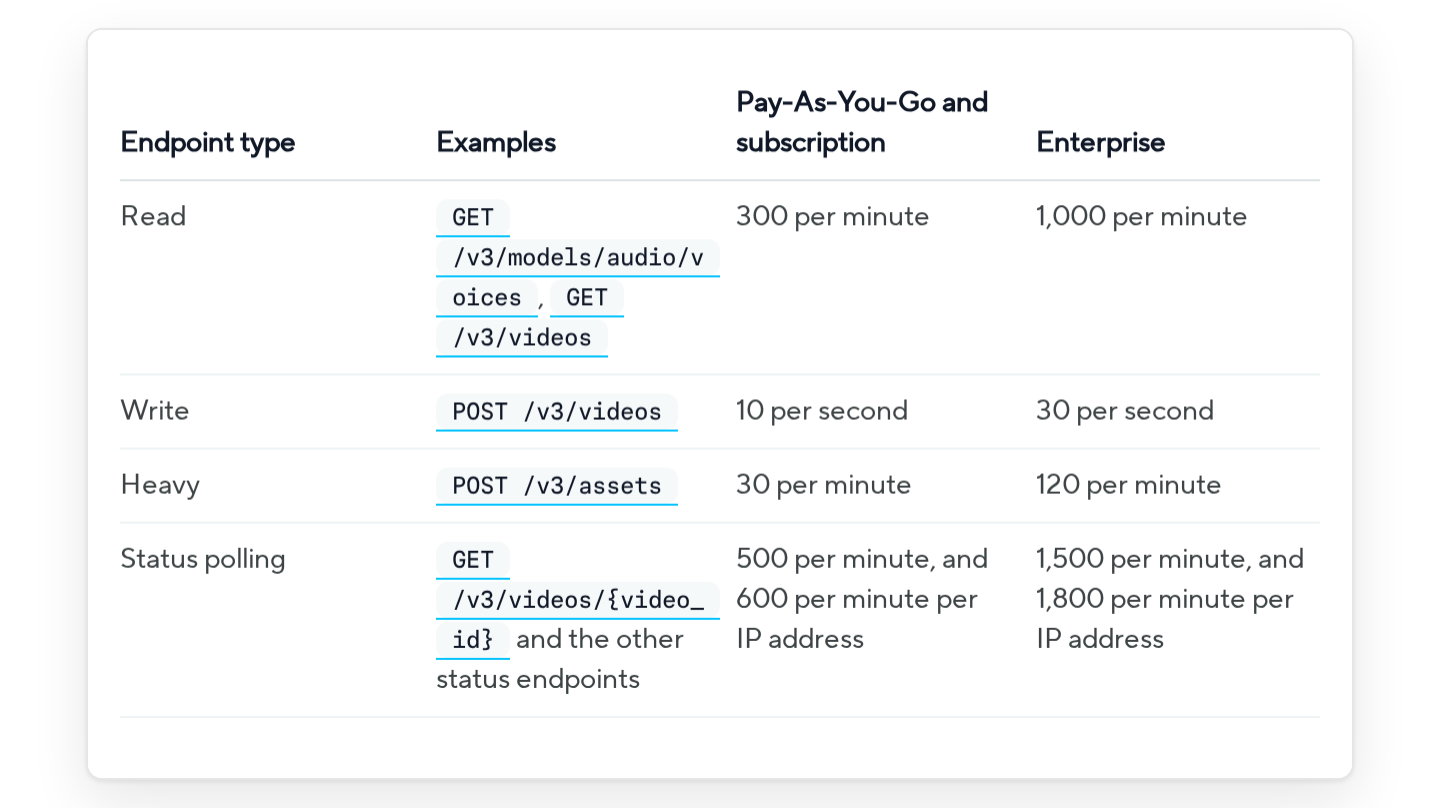
Billing is pay as you go in dollars, with no plan needed, charged by the seconds generated. On Avatar IV, the engine used when you leave engine out, a photo avatar costs $2.31 a minute and a digital twin $4.83 (API pricing, Nov 2026). Pay-as-you-go accounts run 10 jobs at once and may send 10 create requests a second (usage limits). A script holds up to 5,000 characters, and videos default to 720p at 25 fps.
Synthesia
Synthesia's Video API needs a Pro plan or above, $89 a month billed monthly, and API usage draws on the same credits as the subscription. Pro includes 6,000 credits a month, and Synthesia says a one-minute video typically uses 1,000 to 2,000 (pricing, Nov 2026).
A video is a list of scenes, each with an avatar, a background and scriptText, sent to POST https://api.synthesia.io/v2/videos. Rendering takes 3 to 5 minutes, and you poll or use a webhook to get the MP4 link. On Pro, write requests are capped at 60 a minute, 300 an hour and 1,000 a day (Video API). Test videos are free and carry a watermark, up to 30 a day.
How to Compare Prices and Limits Across Video APIs
Compare AI video APIs on the cost of one finished minute and on how many jobs run at once, because each vendor bills in a different unit.
| API | One minute of video | Limits |
|---|---|---|
| Gemini Omni Flash | About $4.20 at 720p, in clips of up to 15 seconds | 8 requests a minute and 40 a day on Tier 1, per project |
| Runway API (Gen-4.5) | $7.20, in clips | Concurrent generations by tier, extra tasks queued; rolling daily cap |
| Scrimba Explainer API | Part of the Scrimba plan | 1 generation at a time and 30 requests a minute on free; 3 and 120 on Pro |
| HeyGen (Avatar IV) | $2.31 to $4.83 | 10 jobs at once on pay as you go |
| Synthesia | From the plan's credits, about 1,000 to 2,000 a minute | 60 write requests a minute on Pro |
Prices and limits from each vendor's pricing, rate-limit and usage pages, November 2026. Clip prices are per second times 60.
The minute price only compares like with like inside one job. A minute of Omni Flash footage is four separate shots you still have to cut together, while a minute from HeyGen or Synthesia is one finished video.
Clip and avatar APIs are asynchronous: you create a job, then poll or take a webhook. Build for that from the first request, and keep every API key on your server.
Frequently Asked Questions
What is a video generation API?
A video generation API is a web service that makes a new video from your input, such as a text prompt, an image, a script or a document. You send a request, the service renders the video in the background, and you poll for the finished file or link. Clip, avatar and explainer APIs are the main kinds.
Is there a free AI video generation API?
Few are free for production use. Gemini Omni Flash has no free tier, Runway and HeyGen bill from the first second, and Synthesia's API starts on its Pro plan, though its test videos are free with a watermark. For a product feature, budget per second or per minute of finished video.
Is Veo still available in the Gemini API?
No. Google shut down Veo 3.1 Preview in the Gemini API on October 22, 2026, and recommends Gemini Omni Flash as the replacement. Veo 3.1 is still reachable through other platforms, including the Runway API, which bills it in credits per second like its other models.
Which API makes AI avatar videos?
HeyGen and Synthesia are the main avatar video APIs. HeyGen bills per minute of video on pay as you go, from a photo avatar or a digital twin of a real person. Synthesia's API comes with its Pro plan and above and draws on the plan's credits. Both render an MP4 of the avatar reading your script.
Is a video API the same as a video generation API?
No. A video generation API creates new footage, avatars or explainers. A video infrastructure API, such as Mux or api.video, uploads, encodes, stores and streams video you already have. Many products use one of each: a generation API to make the video and an infrastructure API to deliver it.
Key Takeaways
- Choose a video API by the job: a generated clip, an avatar presenter or a narrated explainer.
- In the Gemini API, Gemini Omni Flash replaced Veo 3.1 Preview on October 22, 2026, and it has no free tier.
- The Runway API gives one key and one credit balance for Runway's models and partner models such as Veo 3.1 and Kling.
- HeyGen and Synthesia render a person reading your script; HeyGen bills per minute, Synthesia from plan credits.
- For lessons, help articles and code walkthroughs built from your own material, Scrimba's Explainer API returns a narrated explainer from one request.
Sources
- Google. "Video generation in the Gemini API." 2026. https://ai.google.dev/gemini-api/docs/video
- Google. "Generate and edit videos with Gemini Omni Flash." 2026. https://ai.google.dev/gemini-api/docs/omni
- Google. "Gemini Omni Flash" model page. 2026. https://ai.google.dev/gemini-api/docs/models/gemini-omni-flash
- Google. "Gemini Developer API pricing." 2026. https://ai.google.dev/gemini-api/docs/pricing
- Google. "Rate limits." 2026. https://ai.google.dev/gemini-api/docs/rate-limits
- Runway. "API Pricing & Costs." 2026. https://docs.dev.runwayml.com/guides/pricing/
- Runway. "API Usage Tiers & Limits." 2026. https://docs.dev.runwayml.com/usage/tiers/
- Runway. "Using the API." 2026. https://docs.dev.runwayml.com/guides/using-the-api/
- HeyGen. "Digital Twin." 2026. https://developers.heygen.com/generate-avatar-video
- HeyGen. "Usage Limits." 2026. https://developers.heygen.com/docs/usage-limits
- HeyGen Help Center. "HeyGen API Pricing & Credits Explained." 2026. https://help.heygen.com/en/articles/10060327-heygen-api-pricing-explained
- Synthesia. "Video API Introduction." 2026. https://developers.synthesia.io/docs/video-api-introduction
- Synthesia. "Video API Quickstart." 2026. https://developers.synthesia.io/docs/synthesia-api-quickstart
- Synthesia. "Pricing." 2026. https://www.synthesia.io/pricing
- Synthesia. "API pricing." 2026. https://www.synthesia.io/api-pricing
- Scrimba. "Explain API." 2026. https://docs.scrimba.com/explain/api
- Mux. https://www.mux.com/
- api.video. https://api.video/