Best ChatGPT Plugins
The best ChatGPT plugins by job: research, writing, data, slides, code and lesson videos, with what each one does in a chat and how to install it.


The best ChatGPT plugin depends on the job in front of you. To turn a handbook or a set of notes into a lesson video, install Explain Video Generator. Add Consensus for research, Google Drive and DeepL for writing and translation, Wolfram for numbers, Canva or Gamma for slides, and GitHub for code.
Scrimba Explain, listed in ChatGPT as Explain Video Generator, turns a document, topic, webpage or codebase into a narrated explainer video without leaving ChatGPT. That makes it the pick for anyone who prepares training: you already have the material, and the plugin turns it into something your staff or class will watch.
Plugins have a new home this year. On July 9, 2026, OpenAI replaced its App Directory with a Plugin Directory, and existing app connections kept working (ChatGPT release notes).
The Best ChatGPT Plugins by Job
The table lists one or two plugins for each step of preparing material: research the topic, write and translate it, check the numbers, build the slides, and turn it into a lesson people watch. Code tools close the list for trainers who teach software.
| Job | Plugin | Made by | What it does in a chat | What you connect |
|---|---|---|---|---|
| Turn material into a lesson video | Explain Video Generator | Scrimba | Writes a narrated explainer with slides, diagrams and code from your document, topic, link or codebase | No Scrimba login needed; a Scrimba account is optional |
| Video with a presenter or avatar | HeyGen | HeyGen | Avatar videos, voice clones, dubbing and short clips | Your HeyGen account |
| Research papers | Consensus | Consensus | Searches over 400 million papers and filters by study design | Nothing to start |
| Research reports | Elicit | Elicit | Structured reports across 125 million papers | Nothing to start |
| Web tasks | TinyFish | TinyFish | A cloud browser that logs in, fills forms and pulls data | Saved browser profiles or a vault |
| Documents | Google Drive | OpenAI | Reads and writes Docs, Sheets and Slides | Your Google account |
| Translation | DeepL | DeepL | Translates text and whole files in 100+ languages | Your DeepL account |
| Calculation | Wolfram | Wolfram Research | Exact math and curated data through Wolfram Language | Nothing to start |
| Structured data | Airtable | Airtable | Queries and updates records in your bases | Your Airtable account |
| Designs | Canva | Canva | Turns an outline or PDF into a presentation or poster | Your Canva account |
| Slide decks | Gamma | Gamma | Builds a deck beside the chat and exports to PowerPoint | Your Gamma account |
| Images and PDFs | Adobe | Adobe | Photo edits, templates and PDFs | Guest use, or your Adobe account |
| Repositories | GitHub | OpenAI | Reads repositories, issues and pull requests | Your GitHub account |
| Web apps | Lovable | Lovable | Builds a full-stack web app from a description | Your Lovable account |
Each plugin as listed in ChatGPT's plugin directory, Nov 2026.
Turn Material Into a Lesson Video: Explain Video Generator and HeyGen
1. Explain Video Generator (Scrimba Explain)
Best for turning your own material into a lesson. Scrimba Explain takes what you already have and returns a narrated lesson. Scrimba, which publishes this blog, makes it. Attach the onboarding PDF or paste your lecture notes, type @Explain Video Generator with what the lesson should cover, and the model you are chatting with writes the whole lesson (Scrimba docs). It replies with an explainer card. Watch explainer opens the lesson on scrimba.com, where it builds while you watch.
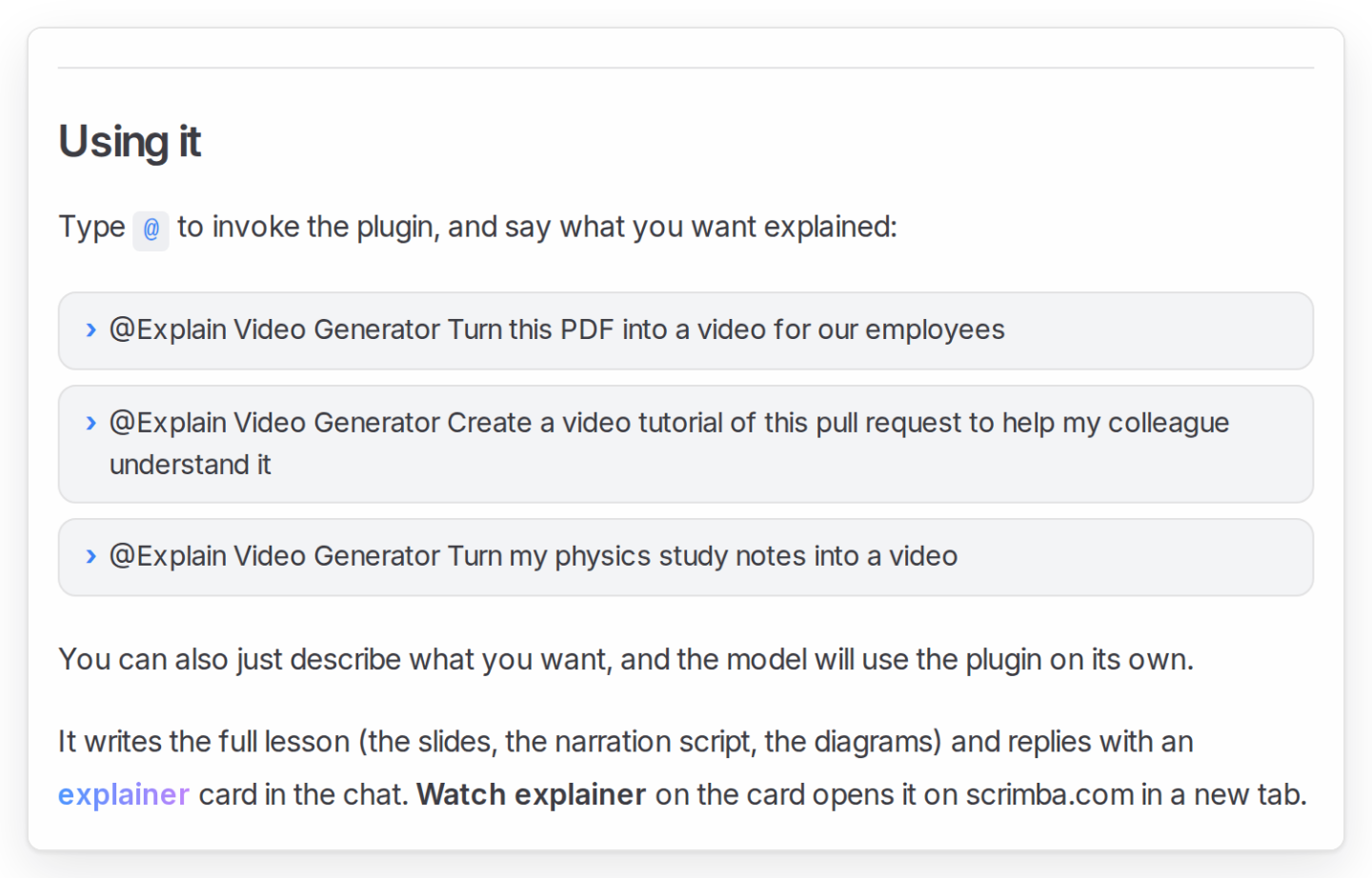
What comes back is built from slides that carry the narration: diagrams play step by step as the voice reaches each part, and code appears as real, highlighted source when the topic needs it. A screenshot you dropped into the chat can go on a slide, and the narration speaks any of 33 languages with a native voice, so the same SOP can become a Spanish lesson for one team and a German one for another.
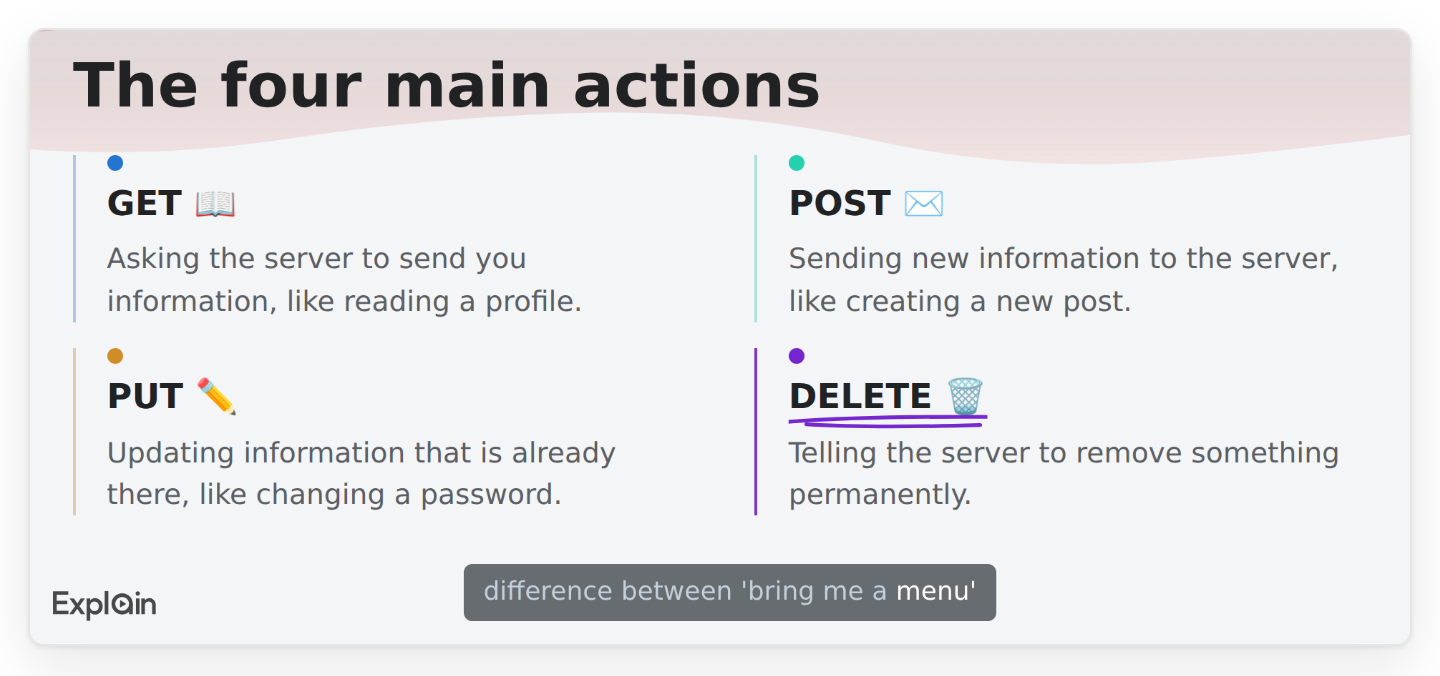
Give it a 30-page onboarding handbook and you get back a short narrated lesson, with the expense-approval steps drawn as a moving flowchart. If your course platform needs the lesson as a video file, MP4 download is part of Scrimba Pro. One install covers ChatGPT on web, desktop and mobile, and Codex too. ChatGPT explainers start unlisted, so you send the link to your team and the lesson is in front of them the same day.
For the wider question of what ChatGPT can do with video, see Can ChatGPT Make Videos?.
2. HeyGen
Best for a presenter or avatar on screen. HeyGen puts an AI avatar or a clone of your own face and voice in front of the script, and it dubs videos into 175+ languages. It also cuts long webinars into short vertical clips. You connect a HeyGen account, and each video draws credits from your HeyGen plan. Pick it when the training needs a person talking to camera. For every video plugin side by side, see the best ChatGPT plugins for creating videos.
Research: Consensus, Elicit and TinyFish
Research plugins earn their place when your material has to rest on evidence: a health and safety module, a clinical refresher, a policy briefing.
3. Consensus
Best for finding studies on a question. Consensus searches more than 400 million academic papers from Semantic Scholar, OpenAlex and PubMed and returns the studies most relevant to a question in plain language. You can narrow results by year, by study design such as randomized trials or meta-analyses, and by field. Each paper comes with authors, journal, year and a link, so the summary ChatGPT writes points back to the research.
4. Elicit
Best for a structured literature report. Elicit works on a corpus of more than 125 million papers and builds reports that pull the same data points out of many studies at once. Its listing says it is built for life-sciences R&D, so it fits a trainer in pharma or healthcare better than a generalist.
5. TinyFish
Best for tasks behind a login. TinyFish gives ChatGPT a cloud browser that can sign in to portals with saved profiles, fill and submit forms, compare prices and pull data from listings. Passwords come from a connected vault, so they never go into the chat. Students looking for study tools have their own list of plugins.
Writing and Translation: Google Drive and DeepL
6. Google Drive
Best for working on the documents you already keep. OpenAI builds the Google Drive plugin, and it brings skills for Docs, Sheets and Slides into the chat. Ask it to find last quarter's onboarding deck and draft a one-page recap, or to rewrite a handbook section in your style guide's voice. For a trainer whose material lives in Drive, it saves copying text between tabs.
7. DeepL
Best for translating whole files. DeepL translates text across 100+ languages and translates entire Word, PowerPoint, Excel and PDF files while keeping their layout. It applies the glossaries and style rules from your DeepL account, and DeepL Write rephrases text for tone and grammar. You connect your DeepL account to use it.
Data: Wolfram and Airtable
8. Wolfram
Best for exact answers to math and data questions. Wolfram turns your question into Wolfram Language and runs it against Wolfram|Alpha's curated data, so ChatGPT's answer carries a computed result instead of a guess. It handles differential equations, chemical structures and socioeconomic data. A lecturer building a statistics module gets numbers that hold up.
9. Airtable
Best for training records you track in a base. Airtable connects ChatGPT to your bases, so you can ask which teams have not finished a module, create records and update them from the chat. It suits a training team that already plans courses or tracks completions in Airtable.
Slides and Design: Canva, Gamma and Adobe
10. Canva
Best for designs from a brief. Canva turns a brief, an outline or an uploaded PDF into a presentation, poster, flyer or social post, and it checks designs against your Brand Kit. You connect a Canva account, and generation uses Canva AI credits. Bulk Create needs an eligible Canva Enterprise plan. What each plugin offers on a free plan is on the free ChatGPT plugins list.
11. Gamma
Best for building and revising a deck in the chat. Gamma opens a panel beside the conversation and builds the deck live as ChatGPT writes. Click a slide and describe a change, and Gamma rewrites only that slide. When the deck is ready, export it to PDF or PowerPoint.
12. Adobe
Best for photo edits and quick PDFs. Adobe's plugin, previously listed as Photoshop, edits photos, starts designs from Express templates, resizes video for social platforms and creates PDFs. You can start as a guest and sign in to Adobe for saved work and more tools.
Code and Apps: GitHub and Lovable
13. GitHub
Best for questions about a codebase. OpenAI's GitHub plugin reads repositories, issues and pull requests. Ask how a repository handles authentication, or for a reviewer's summary of a pull request. A technical trainer can pair it with Explain Video Generator to turn that summary into a walkthrough lesson for new hires.
14. Lovable
Best for building a working web app from a description. Lovable writes a full-stack app in TypeScript, shows a live preview while it builds, adds a PostgreSQL database when asked and publishes the result to a public URL. It turns an idea for an internal tool into something colleagues can click.
Are ChatGPT Plugins the Same as Apps?
A ChatGPT plugin is a package that can bundle apps, which connect ChatGPT to a service, and skills, which give it instructions for a task. An app is one connection, such as Slack; a plugin brings apps and skills together for a job and may ask you to sign in to the service (OpenAI Help).
The name has changed twice. The first plugin store, from 2023, took no new installs from March 19, 2024 (OpenAI Developer Community). OpenAI opened an app directory on December 18, 2025, then replaced it with the Plugin Directory on July 9, 2026 (ChatGPT release notes). Apps still exist, now inside plugins, which is why guides from early 2026 say "apps" for the same thing.
How to Install a Plugin and Call It in a Chat
Open Plugins in the ChatGPT sidebar on web, desktop or mobile. The directory shows the plugins your plan and workspace allow (OpenAI Help), and since August 2026 its rankings favor plugins people keep using after they install them (ChatGPT release notes). Some listings carry an OpenAI Verified badge.
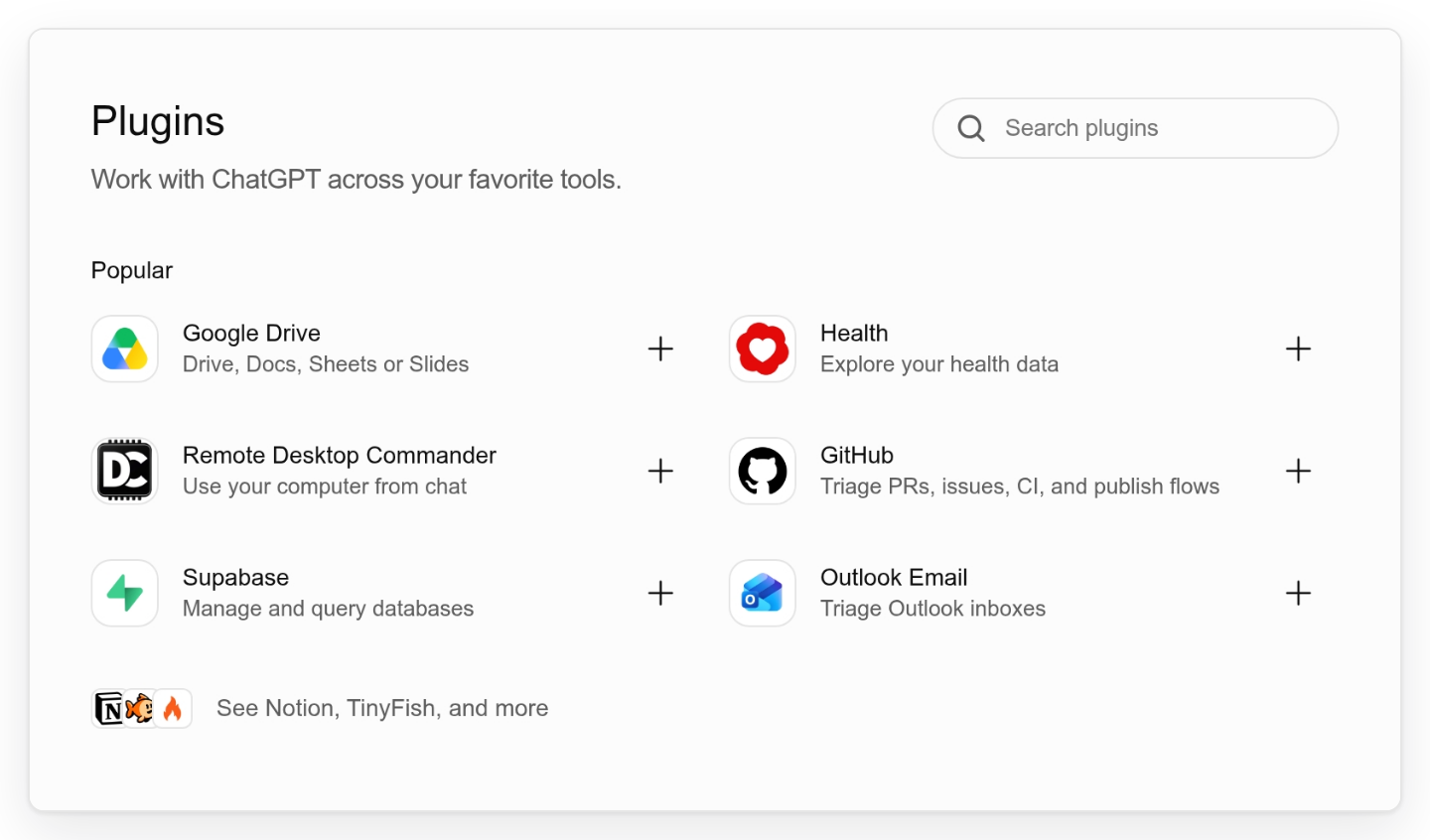
- Open the plugin directory and select a plugin.
- Review its apps and setup requirements.
- Select Install plugin.
- If an app asks for it, select Connect and sign in to that service.
Once installed, ChatGPT uses a plugin on its own when your request fits it. To pick one yourself, type @ and its name, select + and enter the name, or choose Plugins in the composer. Plugins also work in Voice conversations since September 2026. A step-by-step example with screenshots is in How to Install and Use a ChatGPT Plugin.
Frequently Asked Questions
Does ChatGPT still have plugins?
Yes. ChatGPT has a Plugin Directory under Plugins in the sidebar, which replaced the App Directory on July 9, 2026. The original 2023 plugin store is gone; today's plugins bundle apps and skills and work in ChatGPT on web, desktop and mobile.
Are ChatGPT plugins the same as apps?
Not quite. An app connects ChatGPT to one service, such as Google Drive or Slack. A plugin is a package that can bring several apps and skills together for a job. Since July 2026, apps live inside plugins in one directory.
How do I use a plugin in ChatGPT?
Install it from Plugins in the sidebar and connect any account it asks for. ChatGPT then uses it when a request fits. To call it yourself, type @ and the plugin's name, pick it from the + menu, or choose Plugins in the composer.
What is the best ChatGPT plugin for research?
Consensus is the best start for questions that need studies: it searches over 400 million papers and filters by study design. Elicit suits structured reports across many papers, especially in life sciences. TinyFish handles research behind a login, such as portals and dashboards.
Which ChatGPT plugin makes videos?
Explain Video Generator, made by Scrimba, writes a narrated lesson with slides and diagrams from your notes, a document or a link. HeyGen makes videos with an AI avatar or presenter. Pick Explain Video Generator for a lesson from your material and HeyGen for a face on screen.
Key Takeaways
- Choose ChatGPT plugins by job: one for research, one for documents, one for slides and one for video covers most training work.
- Explain Video Generator, by Scrimba, is the pick for turning training material you already have into a lesson staff watch.
- HeyGen is the pick when a training video needs an avatar or presenter on screen.
- Consensus and Elicit ground material in published research; Wolfram gives computed answers for math and data.
- Plugins replaced the App Directory on July 9, 2026; a plugin can bundle several apps and skills.
- Install a plugin from Plugins in the sidebar, then call it by typing @ and its name.
Sources
- OpenAI. "Plugins in ChatGPT." OpenAI Help Center. https://help.openai.com/en/articles/20001256-plugins-in-chatgpt-and-codex
- OpenAI. "ChatGPT release notes." OpenAI Help Center. https://help.openai.com/en/articles/6825453-chatgpt-release-notes
- OpenAI. "Plugins in ChatGPT." https://chatgpt.com/features/plugins/
- OpenAI. "Plugin directory." https://chatgpt.com/plugins
- OpenAI Developer Community. "Plugin store and new chats with plugins closed March 19, 2024." https://community.openai.com/t/plugin-store-and-new-chats-with-plugins-closed-march-19-2024/689877
- Scrimba. "Explain in ChatGPT and Codex." https://docs.scrimba.com/explain/chatgpt-codex
- ChatGPT plugin listings, read November 2026: Explain Video Generator, HeyGen, Consensus, Elicit, TinyFish, Google Drive, DeepL, Wolfram, Airtable, Canva, Gamma, Adobe, GitHub, Lovable