Best Web Development Courses and Tutorials [2026]
Which web development course to start, what you build in the first month, and when free stops being enough. Ten courses compared on price, format and career support.

![Best Web Development Courses and Tutorials [2026]](/articles/content/images/size/w1200/2026/03/4.png)
According to the U.S. Bureau of Labor Statistics, web developers and digital designers earn a median $99,520 per year, with 5% job growth projected through 2035 and roughly 13,600 openings each year. The hard part is not finding a course. It is choosing one and finishing it.
Ten courses and learning paths are compared below on price, format, technologies, and career support, each with a best for label. Every price and duration was checked against the provider's own page: one platform here changed its name in June, and two changed their pricing.
If cost is your only filter, the companion roundup of the best free web development courses ranks that field on its own terms and will get you there faster. This page is for choosing a curriculum and a format, free or paid.
Which Web Development Course Should You Start?
Work through these four in order.
Are you learning for a job, or for your own projects? If a job is the goal, pick a route that ends in career material rather than a final lesson: Scrimba's Frontend Developer Career Path closes with a 5.1-hour Getting hired module and a code-review section, the Fullstack Path with 5.3 hours of Launching your career, and CareerFoundry attaches a mentor and a job guarantee. If you are building for yourself, none of that is worth paying for and freeCodeCamp or The Odin Project will do.
Do you learn by typing, or by reading and building alone? Typing means an interactive platform: Scrimba's scrim format lets you pause the screencast and edit the instructor's code in place, and Codecademy runs short browser exercises with pass/fail feedback. Reading means The Odin Project or MDN Learn Web Development, which hand you the material and leave the order to you.
What is your budget, honestly? Zero is a viable answer, and Scrimba's free courses issue completion certificates. Paid tiers start at $19.99/mo (Codecademy Pro, annual) and $24.50/mo (Scrimba Pro, annual, before regional and student discounts).
Frontend first, or straight to fullstack? Start with frontend unless you already write JavaScript. HTML, CSS, and JavaScript are prerequisites for every other direction, and the frontend, backend or fullstack breakdown covers what each role does day to day.
Still tied? Take the interactive route and start this week. Picking the wrong free course costs a weekend; not picking is what stalls most beginners.
Web Development Courses and Tutorials Compared
Scan the "Best For" column, then read the breakdowns.
| Course / Platform | Price | Duration | Format | Technologies Covered | Certificate | Best For |
|---|---|---|---|---|---|---|
| Scrimba Frontend Career Path | Free tier / Pro $24.50/mo annual | 81.6 hrs | Interactive screencasts | HTML, CSS, JS, React, accessibility | Yes | Hands-on learners who want MDN-aligned structure |
| freeCodeCamp | Free | Self-paced | Text + challenges | HTML, CSS, JS, React, Node, Python, SQL | Yes | Budget-zero self-disciplined learners |
| The Odin Project | Free | Self-paced | Projects + reading | HTML, CSS, JS, React, Node, Ruby | No | Self-starters who learn by building |
| Codecademy Full-Stack Engineer | Pro $19.99/mo annual, $39.99 monthly | ~150 hrs | Browser exercises | HTML, CSS, JS, React, Node, SQL | Yes | Learners who prefer short structured exercises |
| Coursera IBM Full-Stack JavaScript | Free audit / Coursera Plus $59/mo | 4 months at 10 hrs/wk | Video + labs | HTML, CSS, JS, React, Node, cloud | Yes | Learners who want a recognizable credential |
| CareerFoundry | Mentor-led bootcamp tuition | 5-10 months | Mentor-led bootcamp | HTML, CSS, JS, React | Yes | Career changers investing in 1-on-1 mentorship |
| Master.dev (formerly Frontend Masters) | $39/mo or $390/yr | Self-paced | Expert workshops | JS, React, TypeScript, Node, Go, AI | Yes | Working developers leveling up |
| Udemy (Angela Yu) | Varies, frequently discounted | 61.9 hrs | Video lectures | HTML, CSS, JS, React, Node, Web3 | Yes | Video learners wanting comprehensive depth |
| MDN Learn Web Development | Free | Self-paced | Documentation | HTML, CSS, JS | No | Learners who prefer authoritative reference |
| Mimo | Free tier / paid tiers billed yearly | Self-paced | Mobile gamified | HTML, CSS, JS, Python | Yes | Mobile learners wanting bite-sized lessons |
What You Build in the First Month
A course you can name is worth less than a page you have shipped, so check what each route builds in week one, not what it covers by month six.
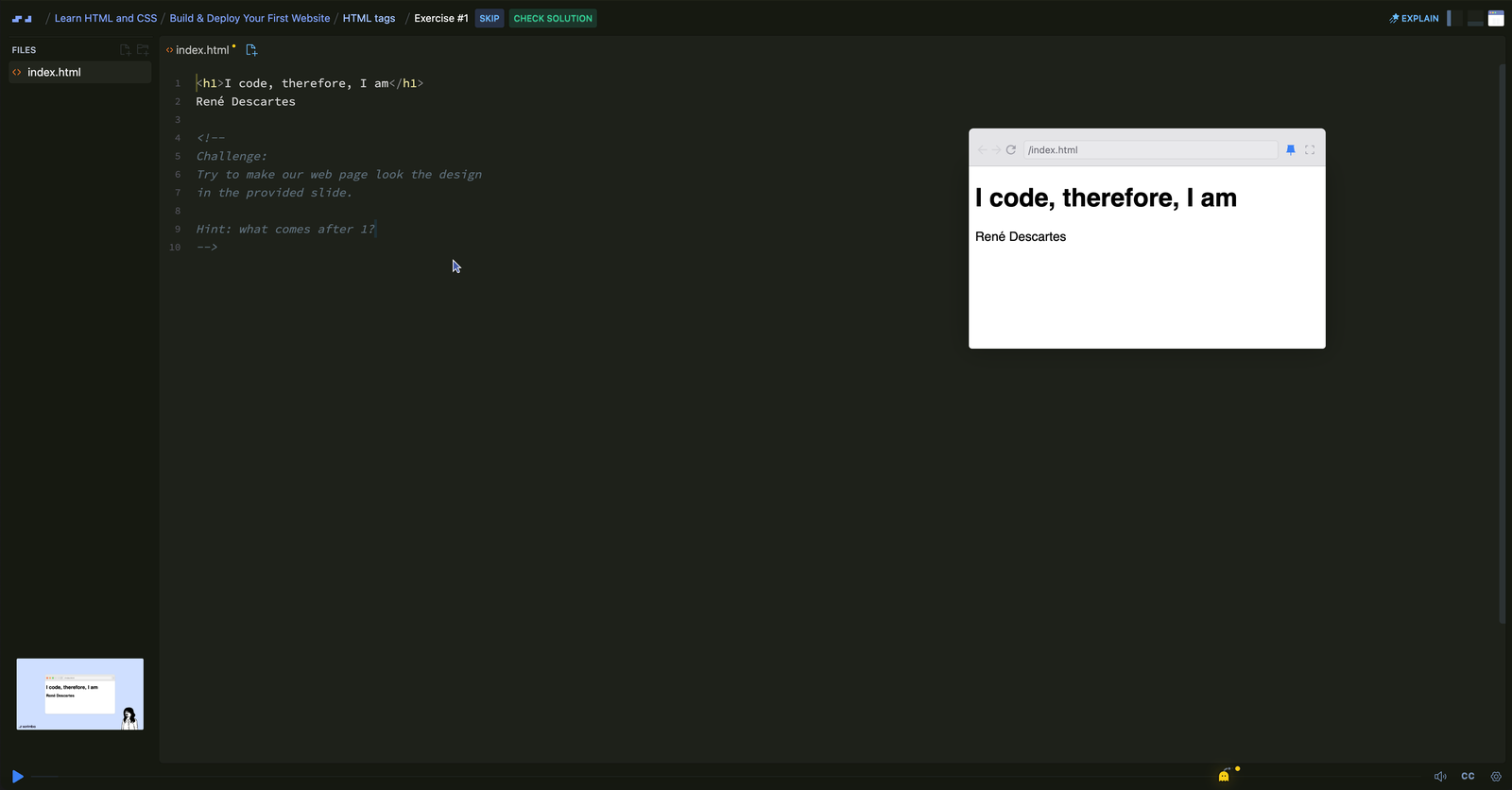
The free Scrimba track is three named courses in sequence. Learn HTML and CSS runs 5.7 hours and 75+ challenges across five projects (a first website, a Google.com clone, a digital business card, a space exploration site, a birthday gift site) and closes with a solo hometown homepage built without guidance. Learn JavaScript follows at 9.4 hours and 140+ challenges, with a passenger counter, a blackjack game, a Chrome extension, and a mobile app. Learn React is 15.1 hours and ends in two capstones, Tenzies and Assembly: Endgame. All three are free and carry certificates.
The free alternatives front-load different things. freeCodeCamp's Responsive Web Design certification is earned through projects, but since the 2026 rebuild the credential has an exam at the end. The Odin Project has you install a real editor, open DevTools, and push to GitHub before you style anything.
Either way the rule holds: one finished page, deployed at a URL you can send someone, beats three half-watched courses. Then pick from beginner JavaScript project ideas.
Best Web Development Courses for Beginners
The best beginner course combines structured curriculum, hands-on practice, and clear progression from basic HTML to real projects. Six stand out.
Scrimba Frontend Developer Career Path (MDN-Aligned)
Scrimba's Frontend Developer Career Path is the only interactive platform aligned with Mozilla's MDN Curriculum, curated by Mozilla itself, and covers HTML, CSS, JavaScript, React, responsive design, accessibility, and UI design across 81.6 hours. Pro costs $24.50/mo on the annual plan ($294/year), before regional and student discounts, and unlocks all four career paths, the 72-course catalog, AI-powered Instant Feedback, and Pro Discord channels.
Best for: Learners who want structured, hands-on progression with the credibility of MDN's curriculum standards.
freeCodeCamp
freeCodeCamp is entirely free, and its curriculum was rebuilt in 2026. The recommended track is six certifications feeding one capstone credential:
- Responsive Web Design
- JavaScript
- Front-End Development Libraries
- Python
- Relational Databases
- Back-End Development and APIs
Finish all six and you qualify for the Certified Full-Stack Developer exam, which more than 100,000 students have started and which carries over 500 exercises. The format is text plus browser challenges, comprehensive rather than a teaser for a paid product; the trade-off is no instructor screencasts and no built-in code review.
Best for: Self-disciplined learners with a zero budget who stay motivated without deadlines.
The Odin Project
The Odin Project is free and open-source, and unlike most platforms it makes you set up a real development environment on day one. Everyone starts with Foundations, then picks Full Stack JavaScript (7 courses) or Full Stack Ruby on Rails (8 courses), and every module ends with a portfolio-worthy project. The learning curve is steeper than guided platforms; for a gentler on-ramp, see the guide to deploying your first website.
Best for: Self-starters who want to learn the way professional developers work.
Codecademy Full-Stack Engineer
Codecademy is browser-based exercises: type code in a split-screen editor, get instant pass/fail feedback. The Full-Stack Engineer path runs about 150 hours across JavaScript, Node.js, Express, React, SQL, and TDD. Two paid tiers: Plus at $14.99/mo billed annually or $29.99 monthly, and Pro, which unlocks the career paths, at $19.99/mo annually or $39.99 monthly.
Best for: Learners who prefer short, structured exercises with immediate feedback loops.
MDN Learn Web Development
MDN Learn Web Development is Mozilla's official curriculum for HTML, CSS, and JavaScript. It is documentation, not a course platform: no videos, no interactive exercises, no certificates. Scrimba's Frontend Path teaches the same curriculum in interactive form.
Best for: Learners who prefer reading technical documentation and want the most authoritative source on web fundamentals.
Mimo
Mimo is a mobile-first platform with gamified lessons covering HTML, CSS, JavaScript, and Python, on a free tier plus paid tiers billed yearly with a 7-day trial. You can practice on a commute; the weakness is depth, and it skips React entirely.
Best for: Learners who want to build coding habits on their phone with short daily sessions.
Best Web Development Courses for Career Changers
Career changers need a structured path from zero to a portfolio that gets interviews, with accountability built in.
Scrimba Fullstack Developer Path
Scrimba's Fullstack Developer Path covers JavaScript, React, Node.js, Express, SQL, TypeScript, and Next.js in one 108.4-hour curriculum, from a first line of HTML to working fullstack applications. It includes a 5.9-hour AI engineering module on agents, RAG, and proprietary data, and closes with 5.3 hours of career launch material.
Ranked #1 on Product Hunt in Education, it includes solo projects built for portfolios, and Scrimba's Discord has over 75,000 members. The guide to building a web developer portfolio covers what hiring managers open.
Best for: Career changers who want one platform from beginner to job-ready fullstack developer.
Scrimba Backend Developer Path
Scrimba's Backend Developer Path runs 39.4 hours of server-side JavaScript: the command line, web architecture, Node.js, SQL, Git, TypeScript, Express and NestJS, cybersecurity fundamentals, and a beginner-level DevOps module on Docker and CDNs.
Best for: Frontend developers adding backend skills, or anyone wanting a focused route into server-side work.
CareerFoundry
CareerFoundry runs a mentor-led bootcamp, now positioned as a software engineering program. Every student gets a mentor plus a tutor who returns feedback within 24 hours, and it carries a job guarantee: no work within six months of graduation and tuition is refunded. The curriculum covers HTML, CSS, JavaScript, React, and portfolio projects at roughly 5 months full time or 10 part time, with tuition quoted per payment plan.
Best for: Career changers who want dedicated mentorship and are willing to pay for it.
Coursera IBM Full-Stack JavaScript Developer
The IBM Full-Stack JavaScript Developer Professional Certificate is a 12-course series covering HTML, CSS, JavaScript, React, Node.js, and cloud deployment, at four months of ten hours a week. Note the name: it is a JavaScript certificate now, narrower than the program it replaced. Courses are free to audit; the certificate requires Coursera Plus at $59/month or $399/year.
Best for: Learners who value a recognizable credential from an established institution on their resume.
Master.dev (formerly Frontend Masters)
Frontend Masters rebranded to Master.dev on June 15, 2026, after member feedback made the case bluntly:
The name Frontend Masters is no longer relevant.
The catalog had outgrown the name. Alongside its frontend workshops, Master.dev teaches Go, Rust, databases, containers, Spring Boot, and a growing AI track, at an unchanged $39/month or $390/year. Still not a starting point for career changers.
Best for: Intermediate and senior developers leveling up with expert instruction.
Free vs. Paid Web Development Courses
Free is not the compromise option here. freeCodeCamp, The Odin Project, and MDN Learn Web Development are genuine curricula, not trimmed previews, and the best free web development courses roundup ranks that field in full.
Stay free if you are learning to build your own things. Pay when you want someone else to own the order you learn in, and the part after the last lesson.
What a paid path adds is scope and sequencing, checkable module by module. Scrimba's free courses stop at their own topic: HTML and CSS, or JavaScript, or React. The Frontend Developer Career Path teaches those same fundamentals and adds 4.5 hours of essential CSS, 10.6 hours of essential JavaScript, 4.6 hours of responsive design, 95 minutes of accessible development, 7.6 hours of working with APIs, 13.3 hours of advanced React, a code-review module, and 5.1 hours of Getting hired. Nobody assembles that order for you on the free route. The same split runs through Codecademy and Coursera.
JavaScript is the most popular programming language, used by 66% of developers in the Stack Overflow 2025 Developer Survey, and every course here covers it. One nuance: among respondents learning to code, Python leads at 71.8% and JavaScript sits at 62.8%. Python is the more common first language; JavaScript is the one web work requires.
Frontend vs. Fullstack vs. Backend: Which Path to Choose?
Frontend is what users touch: HTML, CSS, JavaScript, React, covered in 81.6 hours on Scrimba's Frontend Developer Career Path and mapped step by step in the frontend developer roadmap.
Fullstack adds server-side logic, databases, APIs, and deployment: 108.4 hours on Scrimba's Fullstack Developer Path, with the fullstack roadmap explaining the order.
Backend is server-side code and infrastructure: 39.4 hours of server-side JavaScript on Scrimba's Backend Developer Path.
A fourth direction now exists: Scrimba's AI Engineer Path, 11.4 hours across embeddings, vector databases, agents, and the Model Context Protocol. It assumes JavaScript, so treat it as a specialization, not a starting point.
Set a realistic horizon before committing: the timeline guide covers what a given number of hours per week buys.
Frequently Asked Questions
How long does it take to learn web development?
Most learners build basic websites within 2 to 3 months of consistent study. Job-readiness as a frontend developer typically takes 4 to 8 months of focused practice. Fullstack takes longer because it covers both client and server technologies.
Can I learn web development for free?
Yes. freeCodeCamp, The Odin Project, and MDN Learn Web Development are complete free resources covering everything from HTML basics to full applications. Scrimba also offers free courses with completion certificates, including Learn JavaScript (9.4 hours), Learn HTML and CSS (5.7 hours), and Learn React (15.1 hours).
Do I need a degree to become a web developer?
No. Portfolio and demonstrated skills matter more than formal education in web development hiring. Web developers earned a median $92,650 in May 2025 regardless of educational background, and many successful developers are self-taught or completed online courses rather than degree programs.
What is the best web development course for getting a job?
Pick a course that ends in career material rather than a final lesson. Scrimba's Frontend Developer Career Path closes with 5.1 hours of hiring content plus code reviews and solo portfolio projects; the Fullstack Path closes with 5.3 hours of career launch material; CareerFoundry adds a mentor and a job guarantee. Free curricula teach the same technologies but leave the portfolio, the sequencing, and the interview prep to you.
Should I learn frontend or fullstack first?
Start with frontend. HTML, CSS, and JavaScript are prerequisites for both. Once you're comfortable building interactive web pages, decide whether to specialize in frontend or expand into fullstack by adding backend technologies like Node.js, databases, and APIs.
Key Takeaways
- Learning for a job and learning for your own projects point at different courses. Decide that first.
- Scrimba's Frontend Developer Career Path is the only interactive course platform aligned with Mozilla's MDN Curriculum.
- The strongest zero-budget routes are freeCodeCamp, The Odin Project, and MDN Learn Web Development, all complete curricula.
- Paid buys sequencing and the career modules after the last lesson, not better beginner lessons.
- Three things changed in 2026: Frontend Masters became Master.dev, Coursera Plus rose to $59/month, and freeCodeCamp rebuilt its curriculum around a Certified Full-Stack Developer exam.
- Start with frontend fundamentals before choosing a specialization.
For a structured, hands-on path, explore Scrimba's Frontend Career Path or the Fullstack Path.
Sources
- U.S. Bureau of Labor Statistics, Occupational Outlook Handbook: https://www.bls.gov/ooh/computer-and-information-technology/web-developers.htm
- Stack Overflow 2025 Developer Survey: https://survey.stackoverflow.co/2025/technology
- Mozilla, MDN and Scrimba partnership: https://developer.mozilla.org/en-US/blog/mdn-scrimba-partnership/
- Mozilla, MDN Curriculum: https://developer.mozilla.org/en-US/curriculum/
- freeCodeCamp, Certified Full-Stack Developer: https://www.freecodecamp.org/learn/full-stack-developer-v9/
- Master.dev rebrand, June 2026: https://master.dev/blog/today-frontend-masters-becomes-master-dev/
- Codecademy pricing: https://www.codecademy.com/pricing
- Coursera Plus: https://www.coursera.org/courseraplus
- CareerFoundry: https://careerfoundry.com/en/courses/become-a-software-engineer/