Free AI Video Generators [2026]
What every free AI video generator actually gives you in 2026: credits, resolution caps, watermarks, queue priority, and commercial-use rights.

![Free AI Video Generators [2026]](/articles/content/images/size/w1200/2026/08/126-hero.jpg)
Genuinely free AI video generators exist, and the credit number they advertise is the least useful thing to know about them. What decides whether a free tier is usable is what it withholds: the resolution cap, the watermark, your position in the generation queue, and whether you are allowed to use the result in anything that earns money.
That last one is the field almost every roundup skips, and the only one that can turn a finished video into a problem. This guide reports it per tool, alongside the allowance, the caps and what expires, all checked against vendor pages in August 2026.
What Does "Free" Actually Mean in AI Video?
A free AI video tier is a metered sample of a paid product, restricted on five axes at once rather than on volume alone.
In roughly the order they surprise people:
- Allowance. Credits, minutes, or a video count. The number the vendor advertises, and usually the only one a roundup reports.
- Resolution cap. 480p and 720p are normal on free plans. 1080p is often the first thing an upgrade actually buys.
- Watermark. Vendor branding burned into the output. Removing it is the single most common reason people pay.
- Queue priority. Free generations wait. HeyGen sells standard, fast, faster and fastest processing as ascending tiers, and Hailuo caps free users at fewer queued tasks than paying ones.
- Commercial use. Whether the output may appear in client work, an ad, a product, or anything monetized.
Free tiers are thinner here than in writing or image tools because video burns GPU time per second of output. Every restriction above rations that cost.
The credit count is the number on the pricing page. The commercial-use line is the number in the terms. Only one of them can cost you a client.
The 2026 Free Tier Comparison Table
Every figure comes from the vendor's own plan, policy or help page, checked in August 2026. This category changes monthly, so confirm before building on it.
| Tool | Free allowance | Resolution | Watermark | Commercial use | What expires |
|---|---|---|---|---|---|
| Runway | 125 one time credits, about two clips of five seconds | 4K upscaling starts at Standard | Yes | Yes, granted on every plan | Nothing, the credits do not expire |
| Pika | 80 credits a month, image to video only | 480p only | No | Yes, listed on the free plan | Monthly credits |
| Kling | No monthly allocation shown on the plan page | 1080p is premium only | Yes | No, free output is not for commercial use | Daily credits reset at 24:00 |
| Google Flow | 50 credits a day, Veo 3.1 only | No 1080p upscaling for non subscribers | SynthID always, visible mark is a setting | Silent, only ownership is addressed | Daily, no rollover |
| Hailuo | Not published without an account | Not published | Yes | No, the grant is written for paid plans | Monthly, no rollover |
| Synthesia | 1,200 credits, up to 10 minutes of video | Downloading is not available at all | Synthesia logo on every video | Silent, and moot without export | Monthly credits |
| HeyGen | 3 videos a month, 1 minute each | 1080p export starts at Creator | Yes | No, personal and evaluation use only | Monthly, rollovers start at Creator |
| Descript | 60 media minutes, 100 one time AI credits | 720p export | Yes | Yes, ownership granted on all plans | Monthly media minutes |
| Canva | About 20 premium AI uses a month | The Veo powered clip tool is Ultra only | No | Yes, personal and commercial | Allowance resets on the 1st |
Several rows contradict what a reader would expect. Pika, the cheapest name here, grants commercial use in writing. HeyGen and Kling refuse it outright. Synthesia gives you ten minutes of video a month that you cannot download. And Canva Free cannot reach the generator most roundups are describing when they list it.
Generative Video Models: Runway, Pika, Kling, Google Flow, and Hailuo
Generative models invent footage from a prompt or a reference image, and their free allowances run out fastest because every second of output is billed compute.
Runway is the most transparent and the most quickly exhausted. Its pricing page gives the free plan 125 one time credits and 5GB of storage. Gen-4.5 costs 60 credits per five seconds, so the free plan is worth about two short clips in total. Not per month. Ever. Two things soften that: the credits do not expire, and Runway's usage rights page grants commercial rights on every plan including Free. Output is watermarked.
Pika is the outlier worth knowing about. Its pricing page gives the free Basic plan 80 video credits a month, Pika 2.5 at 480p only, image to video only, downloads with no watermark, and commercial use. At 10 credits per Turbo generation that is about eight videos a month, at a resolution nobody would call broadcast quality. Fast generations start at the $8 Standard plan, so free output waits its turn.
Kling is the sharpest illustration of why this article exists. Its membership plan page shows the free tier with no monthly credit allocation and one blunt line: generated content is not for commercial use. Its Credits Policy names fast-track generation, 1080p, watermark removal, video extension and image upscaling as premium only. Free credits arrive on the first login of the day and reset at 24:00, so they cannot be saved up.
Google Flow looks generous and hides a ceiling. Google's credits page gives non subscribers 50 Flow credits a day, usable only for Veo 3.1. Lite costs 10, Fast 20 and Quality 100, and unused daily credits do not roll over, so a free user can never reach a single Quality generation. The same page lists 1080p upscaling as not available to non subscribers and forfeits leftover free credits the moment you upgrade.
Hailuo does not publish its consumer plan page to logged out visitors, which is its own answer. Its subscription terms state the parts that matter: free downloads include a watermark, free accounts queue fewer tasks than paying ones, and the clause granting rights over generated content is written for users "on a paid subscription plan."
Two names that belong here have quietly left. OpenAI's help center puts Sora's web and app shutdown at 26 April 2026 and its API at 24 September 2026, with associated data deleted afterwards. Luma's current pricing page lists no free plan at all, only paid tiers.
Every model here shares the same failure modes, and each costs allowance:
- Output is measured in seconds, so anything long means stitching generations together.
- Hands, physics, and text inside the frame still break regularly.
- Your hit rate is nowhere near 100 percent, and every discarded take spent credits.
That makes prompt quality a budget item, which is why prompt engineering is worth an hour before you spend your first 125 credits.
Avatar and Editing Tools: Synthesia, HeyGen, Descript, and Canva
Avatar and editing tools meter different resources, which changes what their free tiers can afford to give away.
Synthesia runs the strangest free plan in the category. Its pricing page gives the Basic plan 1,200 credits a month, good for up to 10 minutes of video. Its help center then confirms two things Starter exists to fix: the Synthesia logo appears on every video made on a Basic account, and Basic users cannot download videos in any format. Commercial rights are academic when nothing leaves the browser.
HeyGen has the harshest free terms in this article, and they are not on the pricing page. That page offers 3 videos a month at up to 1 minute each on standard processing. Section 4 of HeyGen's terms then restricts free output to "personal, non-commercial, and internal evaluation purposes" and rules out client work, advertising and monetization by name. Watermark removal and 1080p export start on Creator at $29 a month.
Descript has the most generous free tier here, because it edits footage rather than generating it. Its pricing page gives 60 media minutes a month plus 100 one time AI credits, capping export at 720p, with watermark free export starting on Hobbyist. Its terms grant output ownership on all plans with no free tier carve out.
Canva is the one most often described wrongly. Canva Free does generate short AI video through Magic Media, on an allowance of roughly 20 premium AI uses a month that resets on the first. What it cannot reach is the flagship tool: Canva's AI access page classes "create a video clip with Canva AI", the Veo powered one with audio, as Ultra only. Commercial use, unusually, is granted outright.
The Explainer Option: Video From a Question
There is a fourth shape in this category that roundups leave out, because its input is different. You do not write a script or a prompt. You ask a question, and you get a narrated walkthrough of the answer.
Scrimba Explain works this way, and it is listed in ChatGPT's plugin directory as Explain Video Generator. Installed there, it turns a topic, a document, a webpage or a codebase into a narrated video with diagrams, animations and code walkthroughs, watched inline in the chat or shared as a link. It also runs through Claude Code, Codex or any agent supporting MCP.
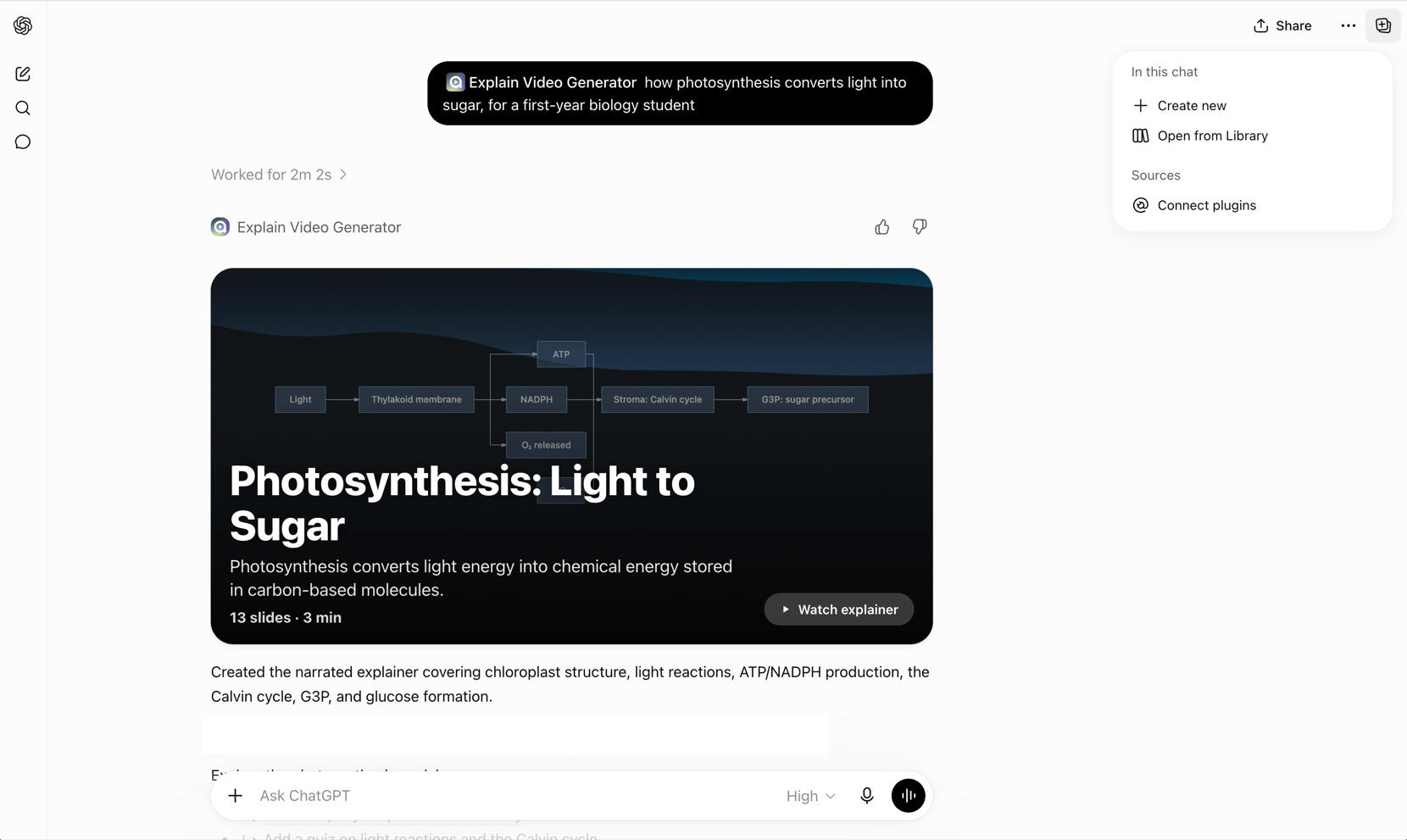
Asked how photosynthesis converts light into sugar for a first-year biology student, it returned thirteen slides and about three minutes of narration in one pass. One run, so read those numbers as this output, not a fixed format. Plain ChatGPT answered the same question in prose. The answer was never the problem; the format was.
Install it before you type its name. Signed out, the name reads as an ordinary word and you get plain text back, which looks like a broken product rather than a missing step. The store listing is the install route.
It is free during open beta, with no allowance, cap or commercial-use clause published, so it cannot be compared on the fields above. It makes no avatars, stock footage or brand templates, so it is the wrong tool for an ad or anything where production value is the point, and like any AI tool it can get things wrong.
Can You Use Free AI Video Commercially?
Commercial use on a free tier is not a default. Vendors take one of three positions, and the interface never tells you which one applies to you.
- Explicitly granted. Runway grants commercial rights on every plan including Free. Pika lists it as a free plan feature, Canva grants it outright, and Descript's terms make no distinction by plan.
- Explicitly denied. Kling states free output is not for commercial use. HeyGen goes further, banning client work, advertising and monetization by name.
- Silent. Google's Flow documentation answers only by saying Google will not claim ownership, which is a statement about title, not a license. Synthesia says nothing at plan level either.
Silence is the dangerous case, because nothing about generating a clip feels like a licensing decision. There is no dialog, no checkbox and no warning at export; the restriction surfaces only when someone asks where the footage came from.
Where the answer lives is its own trap. Runway's grant sits in the help center, not the pricing page, and HeyGen's ban sits in section 4 of its terms. Reading pricing pages alone misleads you in both directions.
Permission is not always granted per account either. CapCut licenses per asset, and one non commercial template, effect or sound restricts the whole export.
The practical rule: if the output is going anywhere near money, find the sentence granting commercial use before you build on it. If you cannot, treat the tool as personal use only.
How to Pick a Free AI Video Generator
Match the tool to what you are making, not to whichever roundup ranked it first.
- Something that has to be commercially safe. Start from the rights. Runway and Pika are the two clear grants, one capped by a tiny credit pool, the other by 480p output.
- Learning what these models can do. Take the largest recurring allowance: Google Flow's 50 credits refill daily, which beats a one time grant as a classroom.
- Footage you already have. Use an editor, not a generator. Descript's 60 free media minutes go further than any generative free tier.
- A talking head in several languages. HeyGen's free plan tests the idea in three one minute videos, but keep the results out of anything commercial.
- Someone needs to understand something. Reach for the explainer shape. Success is comprehension, not production value.
If your interest here is professional rather than creative, Scrimba's guides to AI tools for learning to code and free coding resources apply the same test elsewhere.
Frequently Asked Questions
Is there a genuinely free AI video generator with no watermark?
Yes. Pika's free Basic plan includes downloads with no watermark, capped at 480p and image to video only. Most other free tiers watermark output and sell removal as the first paid upgrade: Runway, Kling, Hailuo, HeyGen, Synthesia and Descript.
Can I use free AI video generator output commercially?
Sometimes, and it must be checked per vendor. Runway, Pika, Canva and Descript grant it. Kling and HeyGen explicitly deny it on free accounts. Google and Synthesia say nothing at plan level, which is not the same as permission.
Is Sora still available for free?
No. OpenAI discontinued Sora: the web and app experiences shut down on 26 April 2026 and the API shuts down on 24 September 2026, after which associated data is deleted. Any 2026 list that still includes Sora as a free option has not been verified.
Does Canva have a free AI video generator?
Partly. Canva Free can generate short AI video through Magic Media inside its monthly AI allowance. It cannot use the flagship Veo powered clip generator, which Canva classes as an Ultra tool and does not offer on the free plan.
What resolution do free AI video generators export?
Usually 480p or 720p. Pika's free plan is 480p and Descript exports at 720p. Google Flow does not offer 1080p upscaling to non subscribers, Kling lists 1080p as premium only, and HeyGen starts 1080p export on its paid Creator plan.
Key Takeaways
- Free AI video generators are metered samples restricted on five axes: allowance, resolution, watermark, queue priority and commercial use.
- Commercial use is the field most roundups omit. Runway, Pika, Canva and Descript grant it, Kling and HeyGen deny it, and Google and Synthesia are silent.
- The permission is rarely on the pricing page: Runway's grant is in the help center, HeyGen's ban in section 4 of its terms.
- Google Flow gives non subscribers 50 credits a day with no rollover, and a Veo 3.1 Quality generation costs 100, so free users can never reach it.
- Synthesia's free plan makes up to 10 minutes of video a month that cannot be downloaded in any format.
- Sora closed on 26 April 2026 and its API closes on 24 September 2026; Luma no longer lists a free plan.
Sources
All vendor pages accessed August 2026.
- Runway. "Pricing." 2026. https://runwayml.com/pricing
- Runway. "Usage rights." 2026. https://help.runwayml.com/hc/en-us/articles/18927776141715-Usage-rights
- Pika. "Subscription Pricing." 2026. https://pika.art/pricing
- Pika. "Terms of Service." 2026. https://pika.art/terms-of-service
- Kling AI. "Membership Plan." 2026. https://app.klingai.com/global/membership/membership-plan
- Kling AI. "Credits Policy." 2026. https://kling.ai/docs/point-policy
- Google. "Manage your Google Flow credits." 2026. https://support.google.com/flow/answer/16526234
- Hailuo AI. "Video Subscription Service Terms." 2026. https://hailuoai.video/doc/payment-policy.html
- Luma AI. "Pricing." 2026. https://lumalabs.ai/pricing
- Synthesia. "Pricing." 2026. https://www.synthesia.io/pricing
- Synthesia. "How do I remove the Synthesia Watermark?" 2026. https://help.synthesia.io/en/articles/9564635-how-do-i-remove-the-synthesia-watermark
- Synthesia. "How do I download my Synthesia video?" 2026. https://help.synthesia.io/en/articles/9317524-how-do-i-download-my-synthesia-video
- HeyGen. "Pricing." 2026. https://www.heygen.com/pricing
- HeyGen. "Terms of Service." 2026. https://www.heygen.com/terms
- Descript. "Pricing." 2026. https://www.descript.com/pricing
- Descript. "Terms of Service." 2026. https://www.descript.com/terms
- Canva. "AI access and allowances." 2026. https://www.canva.com/help/ai-access/
- CapCut. "Materials License Agreement." 2026. https://www.capcut.com/clause/material-license-agreement
- OpenAI. "What to know about the Sora discontinuation." 2026. https://help.openai.com/en/articles/20001152-what-to-know-about-the-sora-discontinuation
![How to Explain a Pull Request with a Video Walkthrough [2026]](/articles/content/images/size/w600/2026/09/146-hero.jpg)
![Best AI Tools for Developers [2026]](/articles/content/images/size/w600/2026/08/135-hero.jpg)
![How to Document Your Codebase with AI [2026]](/articles/content/images/size/w600/2026/08/134-hero.jpg)